Education Series
Setting Up
Lesson 1 of 5
Lesson 1
How Margin Works
Video
Infographics
Lesson Text
What You'll Learn
Before you set up a single account in M1 Finance, you need to understand margin. Not just that The Blueprint uses it — but how it actually works. This lesson covers what margin is, what maintenance requirements mean, how dividends interact with margin, and why the whole system is designed the way it is.
What Margin Is
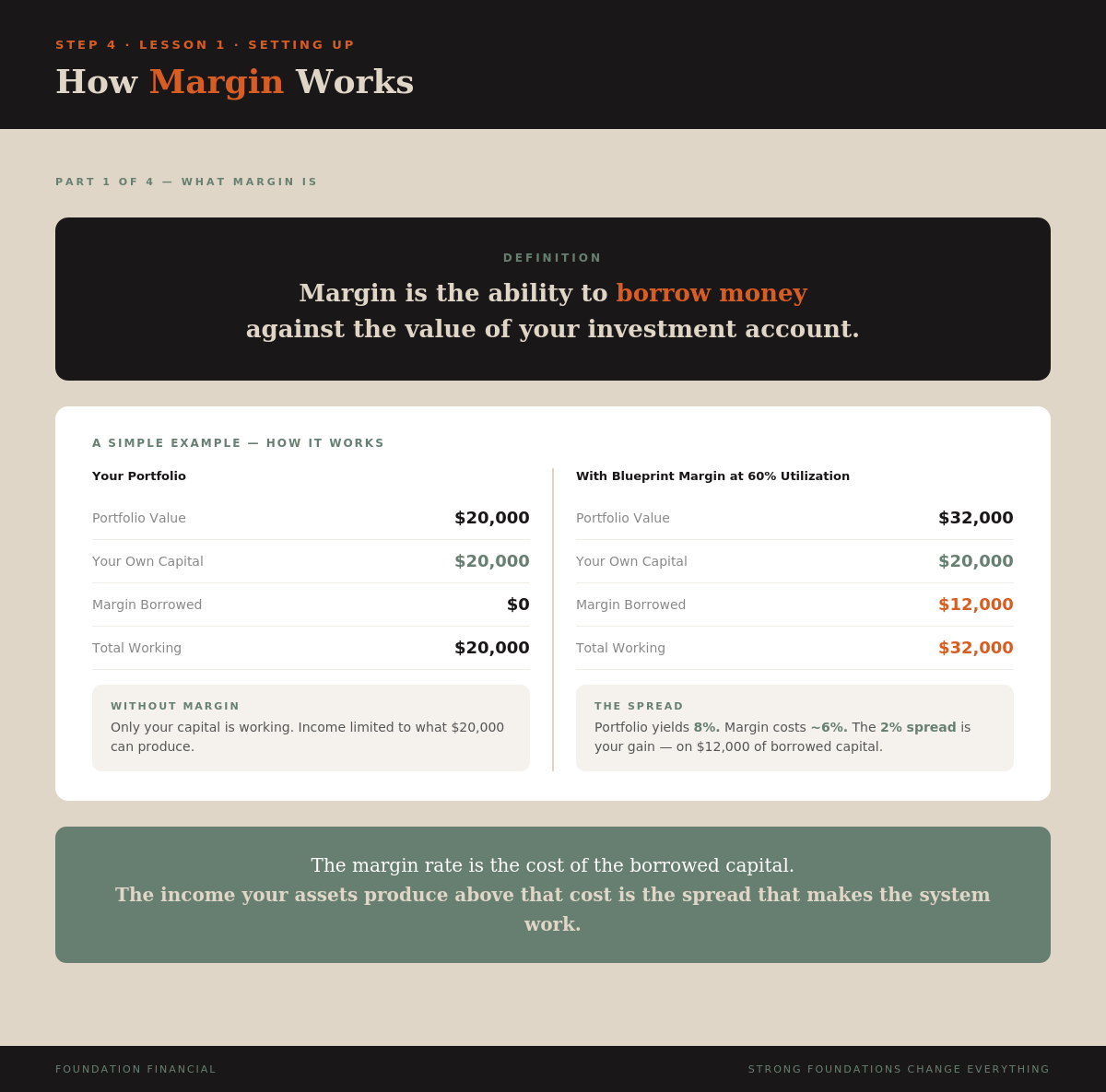
Margin is simply the ability to borrow money against the value of your investment account. When you open a margin-enabled account at M1 Finance, the brokerage looks at your portfolio value and gives you a borrowing limit based on it.
Simple example: if your portfolio is worth $20,000, M1 will allow you to borrow against a percentage of that value. At 60% utilization you would have $12,000 of borrowed capital deployed — bringing your total working capital to $32,000.
The interest you pay on borrowed capital is the margin rate. The income your assets produce above that rate is the spread — and that spread is what makes the system profitable.
If your portfolio yields 8% and margin costs 6%, you are earning a 2% spread on the borrowed capital. That is the engine running underneath every month.
Maintenance Requirements — The Most Important Concept
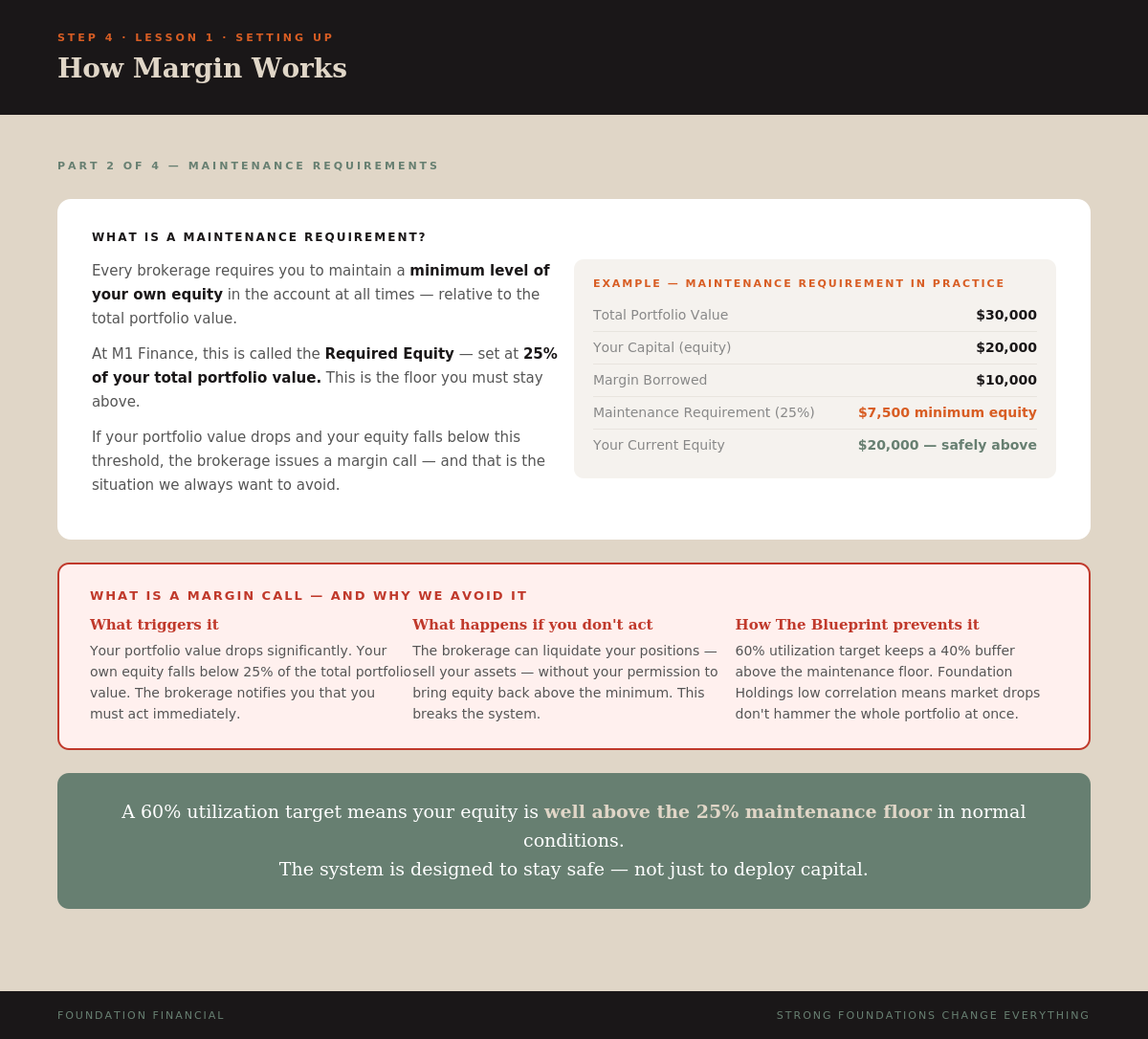
Every brokerage has a minimum equity requirement. At M1 Finance this is called the Required Equity — set at 25% of your total portfolio value at all times.
Here is what that means in practice:
Total portfolio value: $30,000
Margin borrowed: $10,000
Your own equity: $20,000
Maintenance requirement (25%): $7,500 minimum equity
Your current equity: $20,000 — safely above
If your portfolio value drops and your equity falls below 25%, the brokerage issues a margin call. That means you must deposit more capital or sell assets immediately to bring equity back above the minimum. In the worst case, the brokerage liquidates your positions without asking. That breaks the system.
This is why we run at 60% utilization — not higher. That target keeps a significant buffer above the maintenance floor. And it is why Foundation Holdings matter — their low S&P correlation means a market downturn does not hammer the whole portfolio at once, keeping equity above the maintenance line even in rough conditions.
How Dividends Interact With Margin
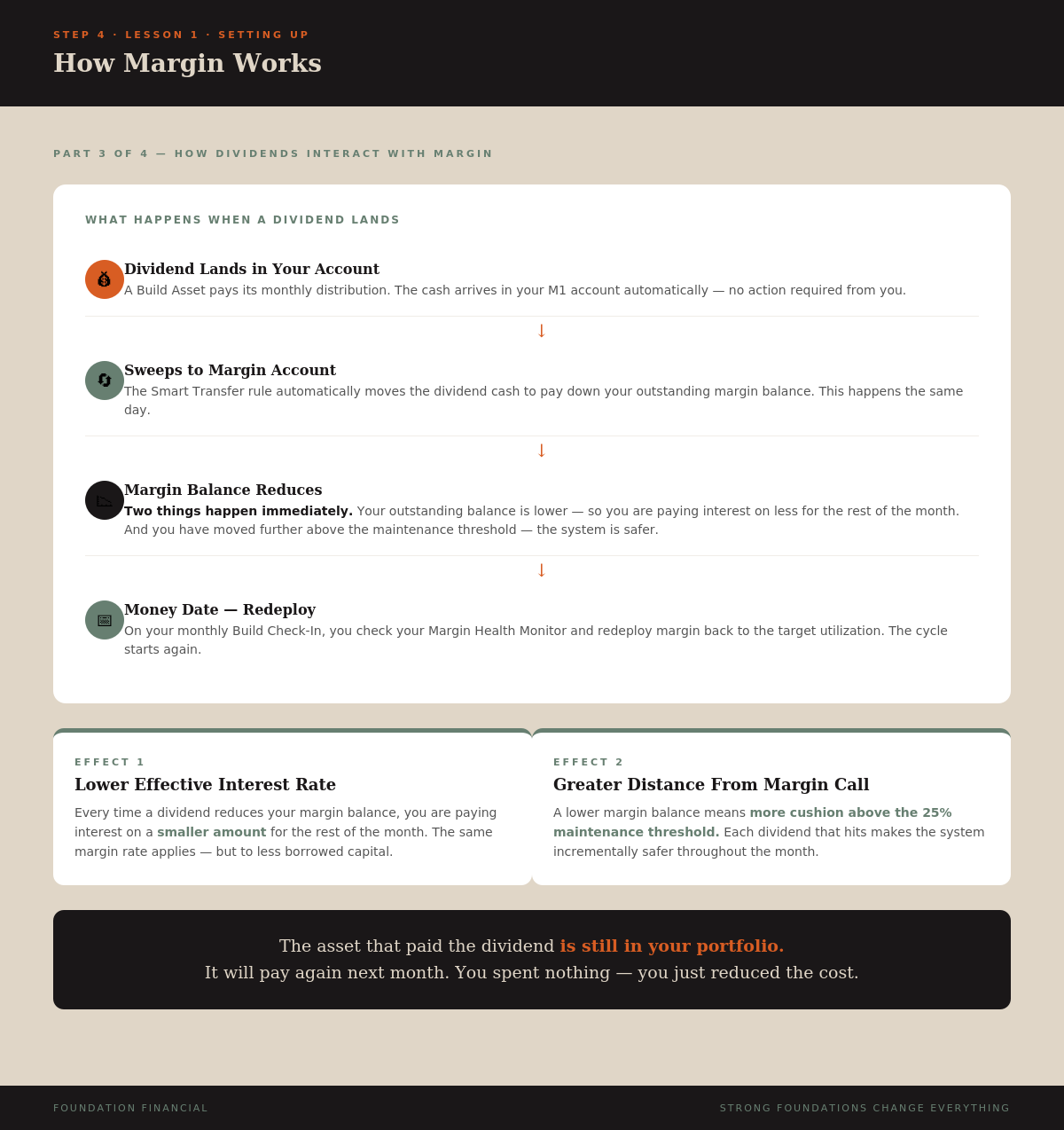
Here is the part that makes The Blueprint elegant. When your Build Assets pay dividends, that cash automatically sweeps to your margin account and reduces your outstanding balance. This does two things simultaneously:
Effect 1 — Lower effective interest rate. The moment a dividend reduces your margin balance, you are paying interest on less borrowed capital for the rest of the month. Same margin rate — smaller balance.
Effect 2 — Greater distance from a margin call. A lower margin balance means more cushion above the 25% maintenance threshold. Each dividend that hits makes the system incrementally safer.
And here is the critical detail: the asset that paid the dividend is still in your portfolio. It will pay again next month. You reduced your cost without spending the asset.
Your Monthly Contribution works the same way — it flows directly to the margin account, further reducing the balance and lowering your interest cost while you wait for your Money Date.
Then on your Money Date, you check the Margin Health Monitor, review market signals, and redeploy margin back to the target utilization. The cycle starts again.
Blueprint Margin vs. Dangerous Margin
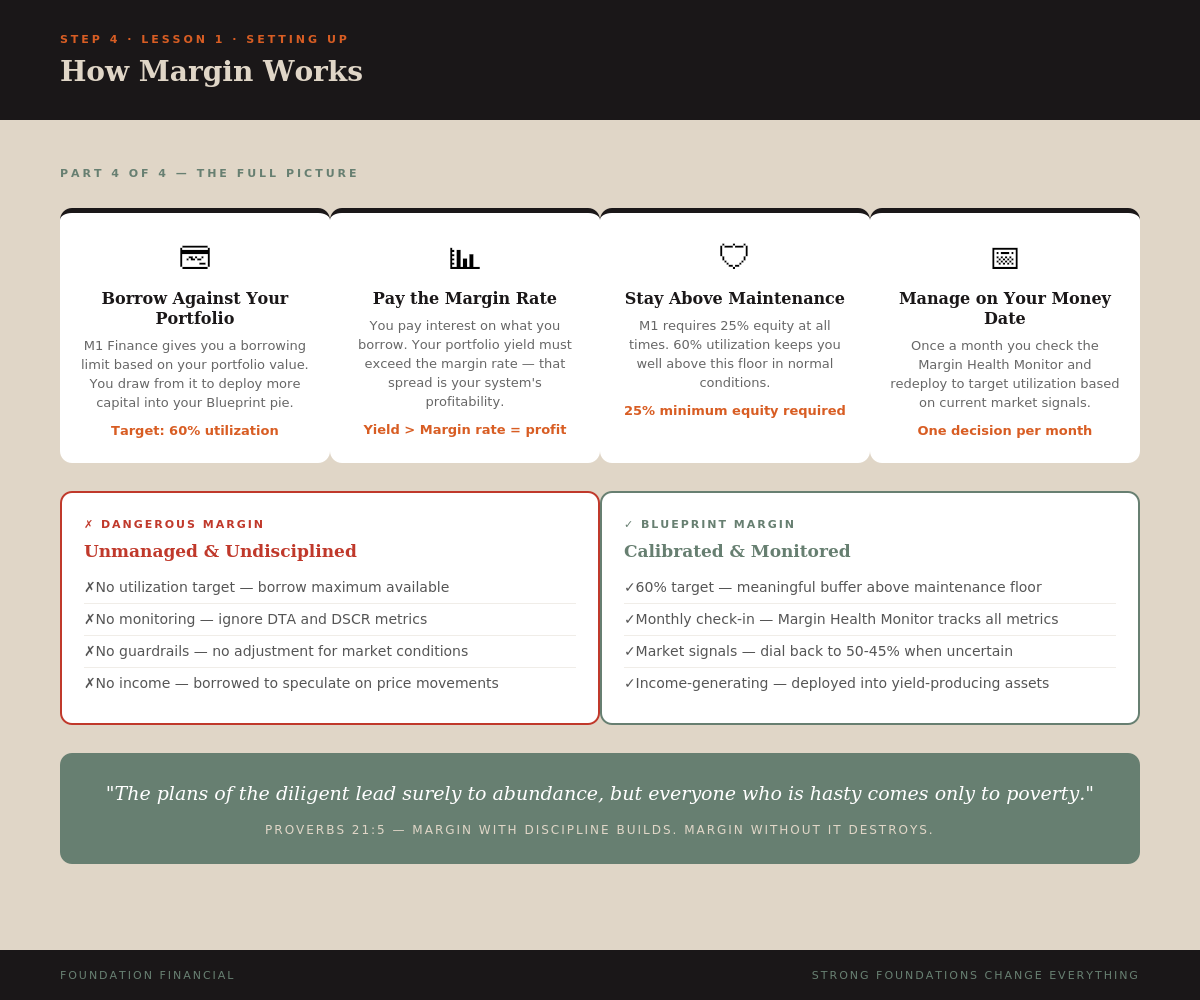
Margin is dangerous when it is unmanaged — no utilization target, no monitoring, no guardrails, and borrowed to speculate on price movements.
Blueprint Margin is different:
- 60% utilization target — meaningful buffer above the maintenance floor
- Monthly Margin Health Monitor check-in — DTA, DSCR, utilization tracked
- Market signal adjustment — dial back to 50-45% in uncertain conditions
- Deployed into income-producing assets — yield covers the cost
Margin with discipline builds. Margin without it destroys.
"The plans of the diligent lead surely to abundance, but everyone who is hasty comes only to poverty." — Proverbs 21:5
Key Takeaway
Margin is borrowed capital deployed into income-producing assets. The spread between yield and margin cost is what powers the system. The 25% maintenance requirement is why we run at 60% utilization with Foundation Holdings providing stability. Dividends reduce your margin balance automatically — lowering cost and increasing safety every month.