Your Storehouse · Lesson 2
Quick Savings vs. Working Savings: How Much Belongs in Each
How much belongs in each — and how to build them together
Video
Infographics

Lesson Text
What This Lesson Covers
This is the practical lesson. We covered the principle of Your Storehouse in Lesson 1. Now we get into the mechanics — what Quick Savings actually is, what Working Savings actually is, how much belongs in each, and how to build them when you are starting from nothing.
Quick Savings: The Same-Day Money
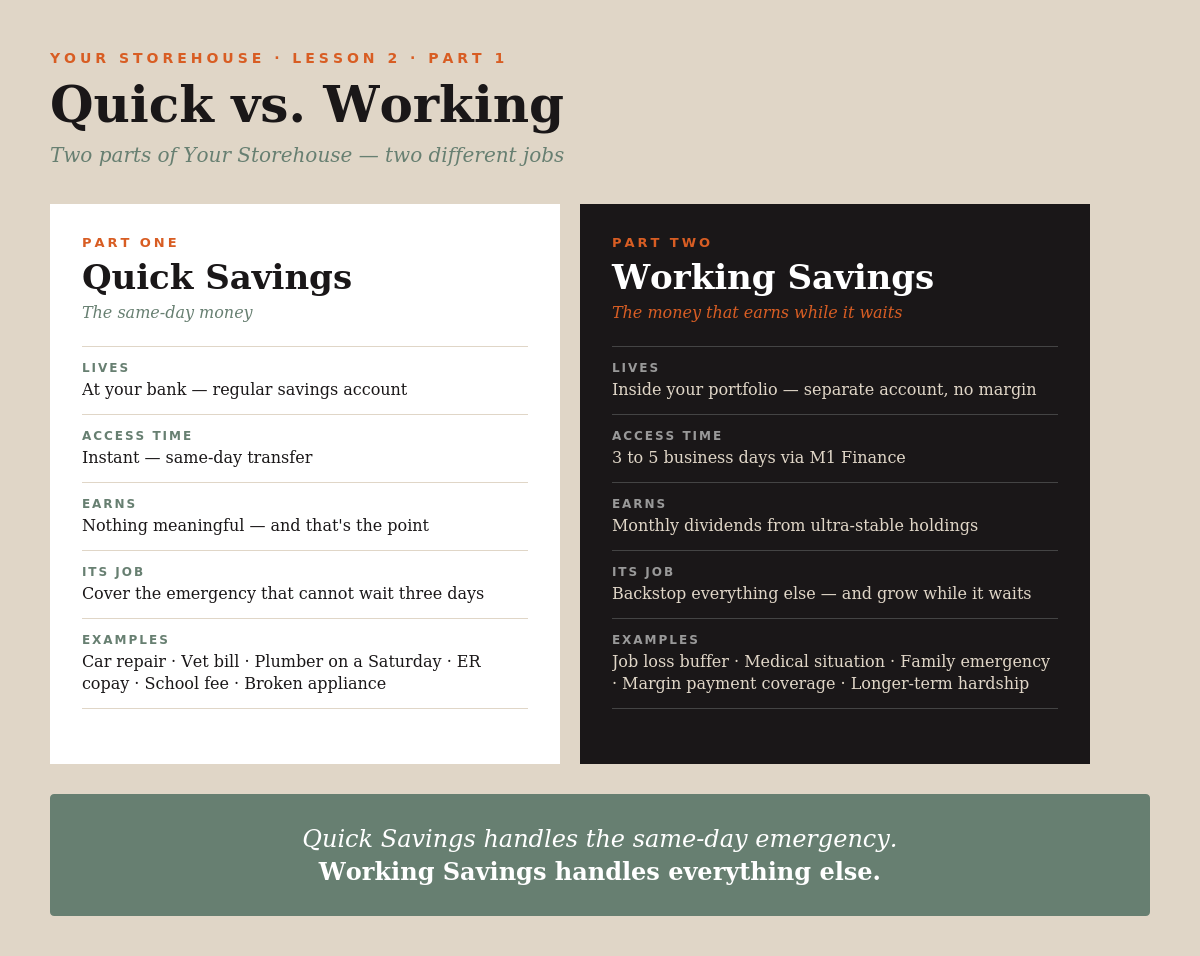
Quick Savings lives at your bank. Regular savings account. The kind of money you can transfer or withdraw the same day. Its only job is to handle the emergency that cannot wait three days.
These are the things you actually face: car repair, vet bill, plumber on a Saturday, ER copay, school fee, a broken water heater. The real emergencies most working families deal with.
And in 2026, these are not cheap. An average car repair runs $800 to $1,200. An ER visit with insurance can hit $1,500 or more between copay and deductible. Even with good coverage, one bad day can cost real money.
How Much Belongs in Quick Savings?
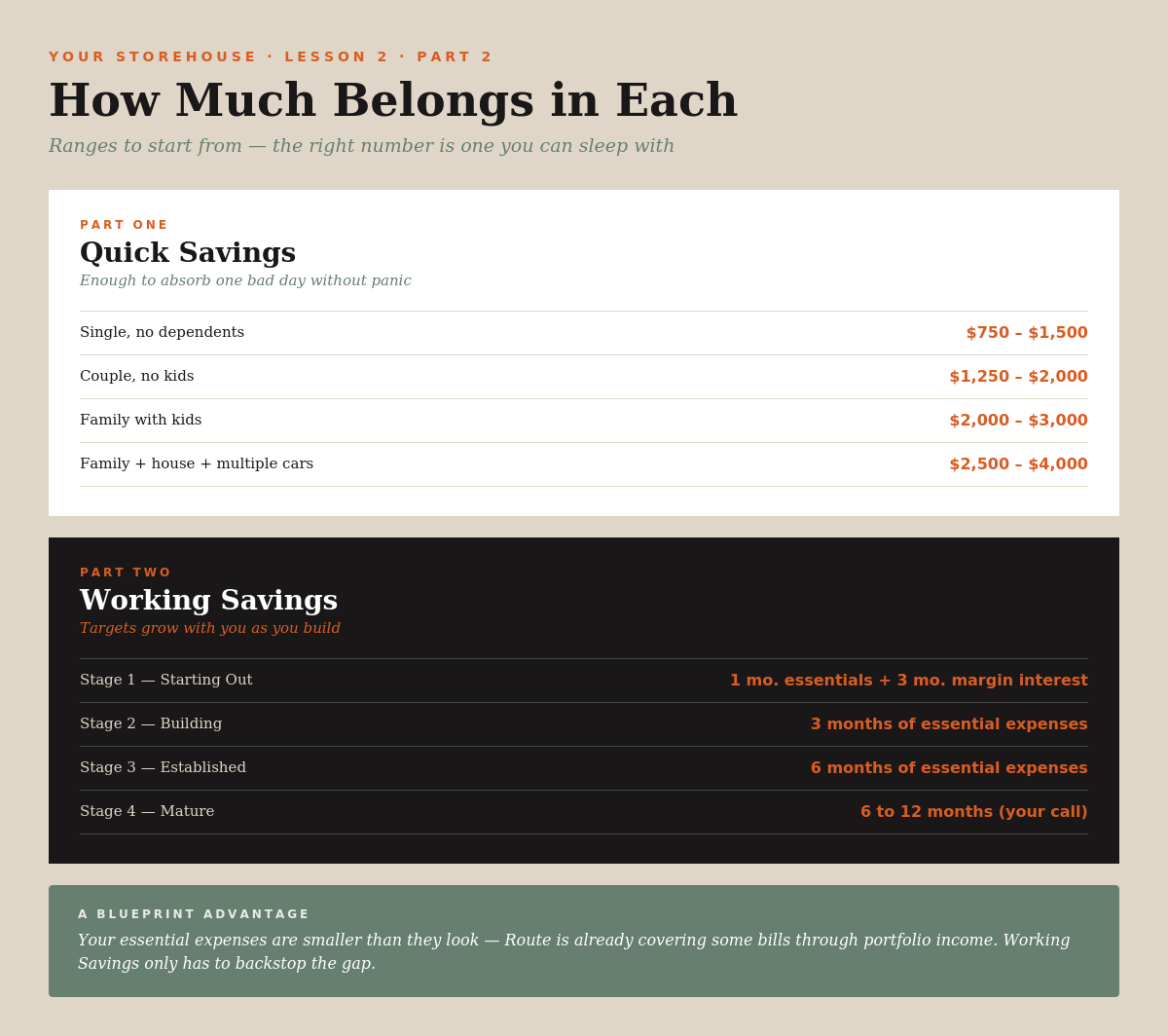
These ranges give you a starting point. The right number for your life is whatever lets you absorb one bad day without panic.
Single, no dependents $750 – $1,500
Couple, no kids $1,250 – $2,000
Family with kids $2,000 – $3,000
Family + house + multiple cars $2,500 – $4,000
Think of it this way: one car repair plus one urgent care visit, with some cushion. The number you can land on and still sleep at night.
Quick Savings is not about earning. It is about peace. It does not have to be working. It just has to be there.
Working Savings: The Money That Works
Working Savings is different. It sits inside your investment portfolio, in a separate account from your main Blueprint pie. No margin. Ultra stable holdings that pay monthly dividends. Same idea as a savings account in spirit — it is part of your safety net — but it is earning while it waits.
When you need it, you place a sell order in M1 Finance and the money lands in your linked bank account in three to five business days. That is the trade-off. It is not instant. But for almost every real emergency in life, three to five days is fine. The bills do not have to be paid the same hour you see them.
Quick Savings handles the same-day emergency. Working Savings handles everything else.
How Much Belongs in Working Savings?
This depends on your stage in the journey.
Stage 1 — Starting Out 1 month essential expenses + 3 months margin interest
Stage 2 — Building 3 months essential expenses
Stage 3 — Established 6 months essential expenses
Stage 4 — Mature 6 to 12 months essential expenses (your call)
Essential expenses means the things you have to pay no matter what — rent or mortgage, utilities, food, insurance, transportation. Not streaming services. Not eating out. Just the must-pay.
Here is something most financial advice gets wrong: for a Blueprint student, your essential expenses are actually lower than for a typical person — because Route is already covering some of your bills through portfolio income. Working Savings only needs to backstop the gap. The number you need is smaller than you might think.
How to Build Them: The Monthly Commitment Framework
Your Monthly Commitment is the money you put in every month. Here is how to split it three ways while you are building.
Scenario 1 — Starting from zero (no Quick Savings, no Working Savings)
Blueprint Portfolio 40 to 60%
Quick Savings 20 to 30%
Working Savings 20 to 30%
Scenario 2 — Quick Savings funded, building Working Savings
Blueprint Portfolio 65 to 85%
Quick Savings 0% (already funded)
Working Savings 15 to 35%
Scenario 3 — Both funded
Blueprint Portfolio 100%
Quick Savings Already funded
Working Savings Grows on its own from dividends
This is the elegant part. Once you have built it, the system maintains it. You do not have to keep contributing forever. Working Savings sits inside the portfolio earning monthly dividends. As your portfolio grows, Working Savings grows with it.
Two Principles for Choosing Within the Ranges
The ranges give you room. Here is how to pick where you land inside them.
Principle One: The faster you want to feel safe, the more you weight toward savings. If you are stressed about safety, pull toward the higher savings end. If you feel solid in your cash income, pull toward the higher portfolio end. Your peace of mind is part of the math.
Principle Two: The lower your cash income margin, the more conservative the build. Thin margin between what comes in and what goes out? Weight savings higher. Substantial monthly surplus? You can lean into the portfolio faster.
These are tools to think with. Not formulas to obey.
A Word About How Working Savings Feels
Working Savings inside the portfolio does not feel as safe as money at the bank. Even though it functionally is. There is something about money you cannot touch instantly that feels less safe.
We want to name this directly, because if you do not, you might push back against the whole idea even when the math is solid.
Two things help. First, time. Once your dividends start hitting every month and you see the system work, the feeling fades. Most students say three or four months is all it takes. Second, knowing the withdrawal mechanics — when you know exactly how to reach this money if you need it, the fear goes away. We cover that in detail in Lesson 3.
The Joseph Principle
Think of Joseph in Egypt. Seven years of plenty and seven years of famine. The storehouse was built during the good years to survive the bad ones. Storing up is biblical wisdom. The wise have always done this.
But Joseph did not bury the grain in a hole. He stored it in granaries where it could be reached when needed. Available — but managed wisely.
That is exactly what Working Savings does. The safety is real. And the wisdom is in how it is held.
What's Next
Lesson 3 covers the specifics of the Working Savings pie — exactly which ETFs go inside, why we chose them, and how to build it inside your M1 Finance account.
Quick Savings handles the same-day emergency. Working Savings handles everything else, while earning real income in the meantime. This is stewardship in action — managing what has been entrusted to you with wisdom.
You are not behind. You are building from here.
This content is for educational purposes only and does not constitute financial advice. Foundation Financial is a financial education and coaching service, not a registered investment advisor.