Your Storehouse · Lesson 3
Building Your Working Savings Pie
Exactly what to hold, how to set it up in M1 Finance, where the dividends go, and how to use it when life hits
Video
Infographics
Lesson Text
What This Lesson Covers
This is the build lesson. You now understand what Working Savings is and how much belongs in it. Today we get specific — exactly which ETFs go inside the pie, why we chose them, how much of each, how to set it up inside your M1 Finance account, where the dividends flow, and how to actually withdraw from it when an emergency happens.
The Principles Behind the Pie
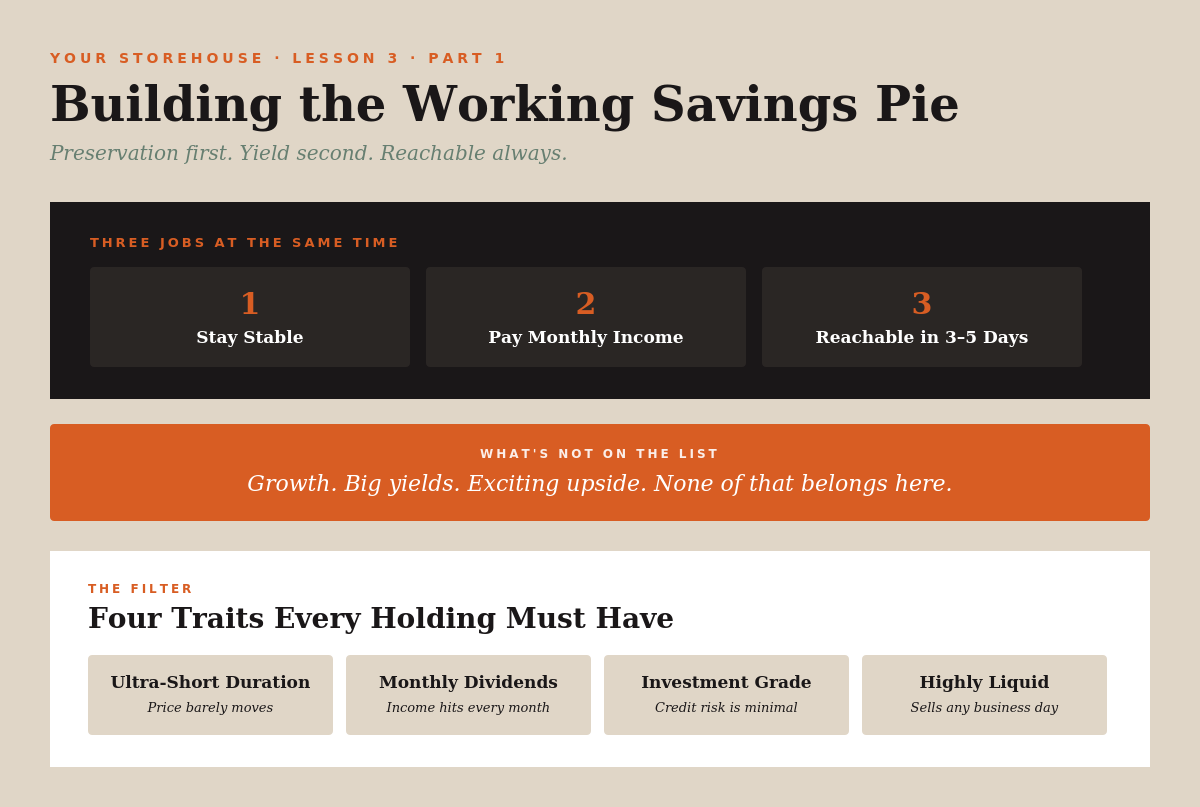
Working Savings has three jobs at the same time. It must stay stable. It must pay real income every month. And it must be reachable in three to five days when you need it.
Notice what is not on that list — growth, big yields, exciting upside. None of that belongs here. Working Savings is part of your safety net. The pie is built around preservation first, yield second.
We look for ETFs with four traits:
Ultra short duration (price barely moves)
Monthly dividends (income hits every month)
Investment grade quality (credit risk is minimal)
High liquidity (sells any business day)
Four ETFs meet all four traits beautifully.
The Four ETFs
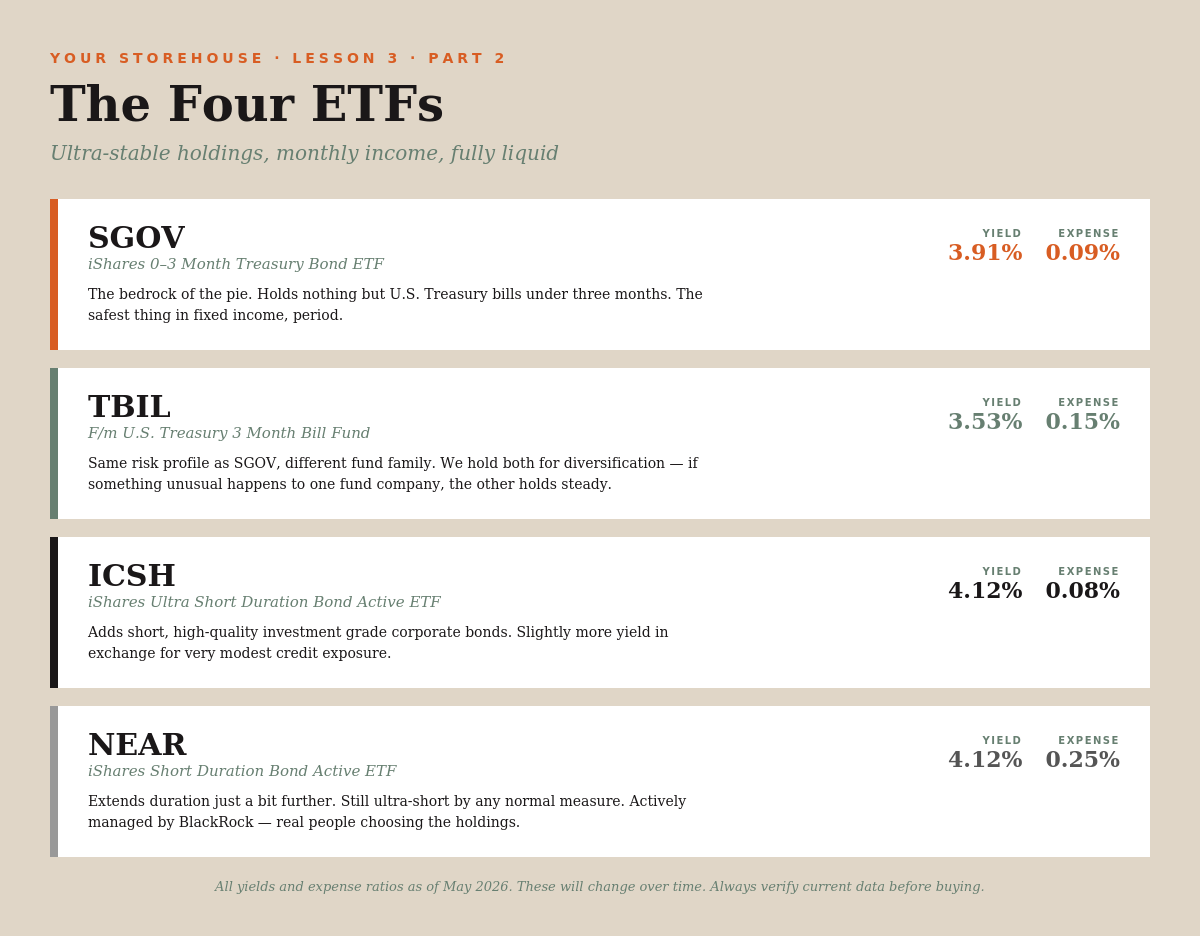
SGOV — iShares 0-3 Month Treasury Bond ETF
The bedrock of the pie. Holds nothing but U.S. Treasury bills under three months. The safest thing in fixed income, period.
Current yield: ~3.91% · Expense ratio: 0.09%
TBIL — F/m U.S. Treasury 3 Month Bill Fund
Same risk profile as SGOV, different fund family. Included for diversification — if something unusual happens to one fund company, the other holds steady. This is not paranoia. This is wisdom.
Current yield: ~3.53% · Expense ratio: 0.15%
ICSH — iShares Ultra Short Duration Bond Active ETF
Adds something Treasury funds do not — short, high-quality investment grade corporate bonds. Slightly more yield in exchange for very modest credit exposure.
Current yield: ~4.12% · Expense ratio: 0.08%
NEAR — iShares Short Duration Bond Active ETF
Extends duration just a bit further. Still ultra short by any normal measure, but slightly more yield. Actively managed by BlackRock — real people making calls about which short-term bonds to hold.
Current yield: ~4.12% · Expense ratio: 0.25%
All yields and expense ratios as of May 2026. These will change over time. Always verify current data before buying.
The Pie
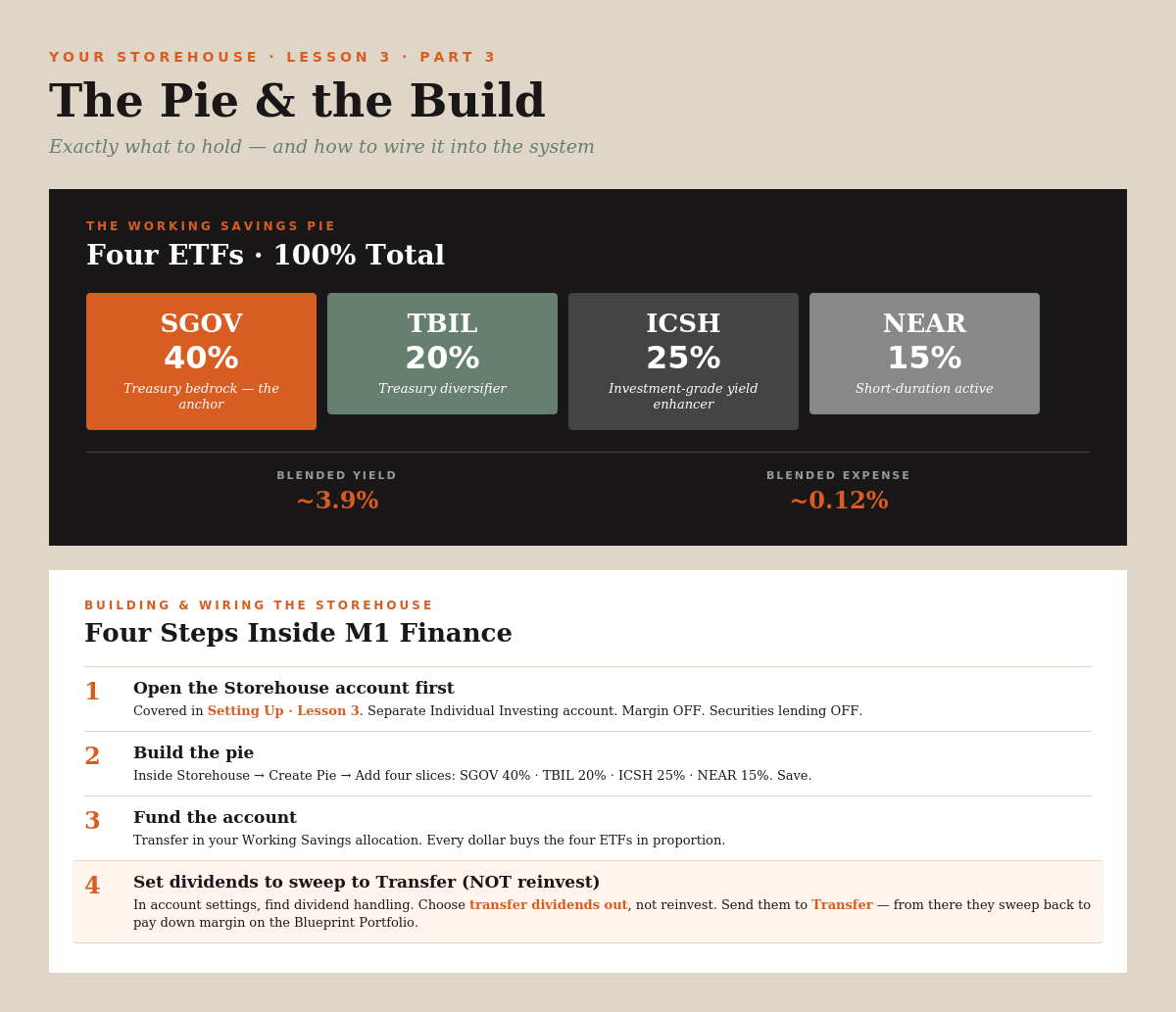
SGOV 40% Treasury bedrock — the anchor
TBIL 20% Treasury diversifier
ICSH 25% Investment-grade yield enhancer
NEAR 15% Short-duration active
Blended yield: ~3.9%
Blended expense: ~0.12%
Sixty percent of your Working Savings sits in pure U.S. Treasuries. Forty percent sits in ultra-short investment grade bonds. Every fund pays monthly. Every fund is liquid every business day. Every fund is stable.
This is what Working Savings is supposed to look like.
Building It Inside M1 Finance
If you have not already opened the Storehouse account from Setting Up · Lesson 3, do that first. The Storehouse is a separate Individual Investing account, completely insulated from margin. Margin OFF. Securities lending OFF.
Step 1 — Build the pie
Inside the Storehouse account, click Create Pie. Add four slices: SGOV at 40%, TBIL at 20%, ICSH at 25%, NEAR at 15%. Make sure the total adds up to 100%. Save the pie.
Step 2 — Fund the account
Transfer in whatever your Working Savings allocation is. Every dollar you deposit will automatically buy the four ETFs in those proportions.
Step 3 — Set dividends to flow to Money In (NOT reinvest)
This is the part most courses get wrong. You do not turn on Auto Invest for this account. The dividends from your Working Savings pie do not reinvest into more SGOV and TBIL — they flow out.
In your Storehouse account settings, find the dividend handling option. Choose to transfer dividends out, not reinvest. Send them to your Money In cash account in the Earn tab.
That is it. The pie is built. The dividends are flowing.
How the Dividends Plug Into the System
Every month, your Storehouse pays dividends from SGOV, TBIL, ICSH, and NEAR. Those dividends land in Money In. From there, the Smart Transfer Rules you set up in Setting Up · Lesson 4 route them through Transfer and on to pay down margin on your Blueprint Portfolio.
This is the elegance of the system. Your Working Savings is doing two jobs at the same time:
- The principal stays stable and available — ready to be reached in 3–5 days when life surprises you.
- The dividends feed back into the engine of the system — paying down your margin every single month, automatically.
Your safety money is also working money. Without you lifting a finger.
How to Withdraw When You Actually Need It
Most courses skip this. Knowing the withdrawal process in advance is critical — because if you do not know how to reach this money, the fear of being locked out will eat at you. And that fear leads to bad decisions.
The withdrawal process:
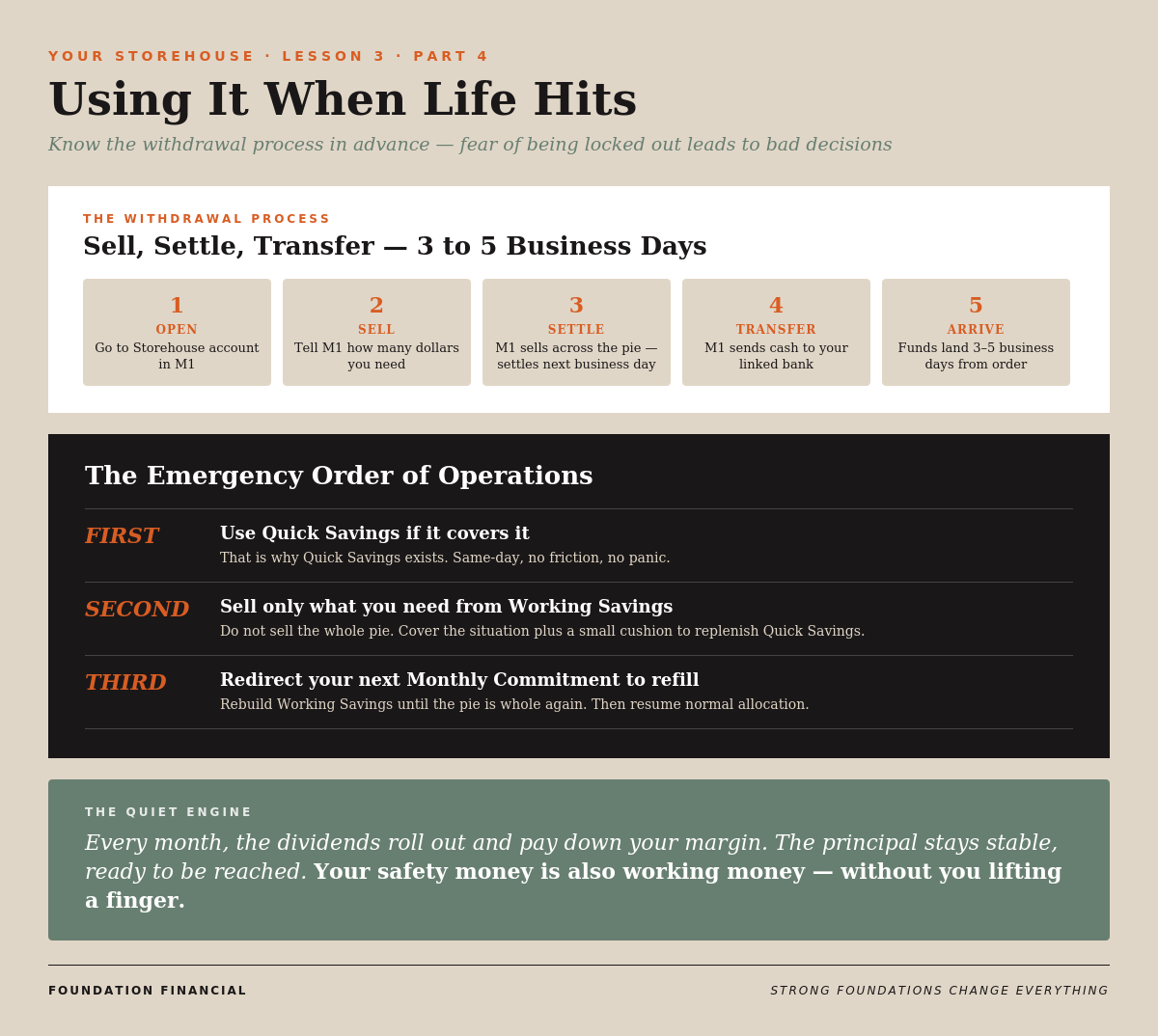
- Open M1 Finance, go to your Storehouse account
- Click Sell. Tell M1 how many dollars you need
- M1 sells across the pie proportionally — trade settles next business day
- M1 transfers cash to your linked bank account
- Total time: 3 to 5 business days from order to bank deposit
That is the trade-off. It is not instant. But the money is yours, reachable, and on the way.
The Emergency Order of Operations
When something happens and you need to use your reserves, follow this order:
First — Use Quick Savings if it covers it. That is why Quick Savings exists.
Second — If Quick Savings is not enough, sell only what you need from Working Savings. Do not panic. Do not sell the whole pie. Sell what you need to cover the situation, plus a small cushion to replenish Quick Savings for the next surprise.
Third — After the emergency passes, redirect your next Monthly Commitment back to Working Savings until the pie is whole again.
This is not panic management. This is stewardship. Calm, planned, sequential. The system was designed for moments like this.
The Quiet Engine
Every month, the dividends roll out and pay down your margin. Without you doing anything. The pie itself stays stable, the principal preserved. The income it generates makes Earn cheaper to run, every single month.
That is the discipline of doing it right — choosing the right holdings, building it in the right proportions, wiring the dividends to feed the system, knowing how to use the principal when the time comes.
That is virtue in action.
What's Next
In the next module we get back to the main Blueprint portfolio and the work of building wealth. But you have done something foundational here. You have built Your Storehouse first. The wise have always done this. Now you have done it too.
You are not behind. You are building from here.
This content is for educational purposes only and does not constitute financial advice. Foundation Financial is a financial education and coaching service, not a registered investment advisor. ETF yields and expense ratios listed are as of May 2026 and will change over time. Always verify current data before investing.