Education Series
The Faithful Steward
Lesson 2 of 3
Lesson 2
The Mature Steward
Video
Infographics
Lesson Text
Student vs. Steward
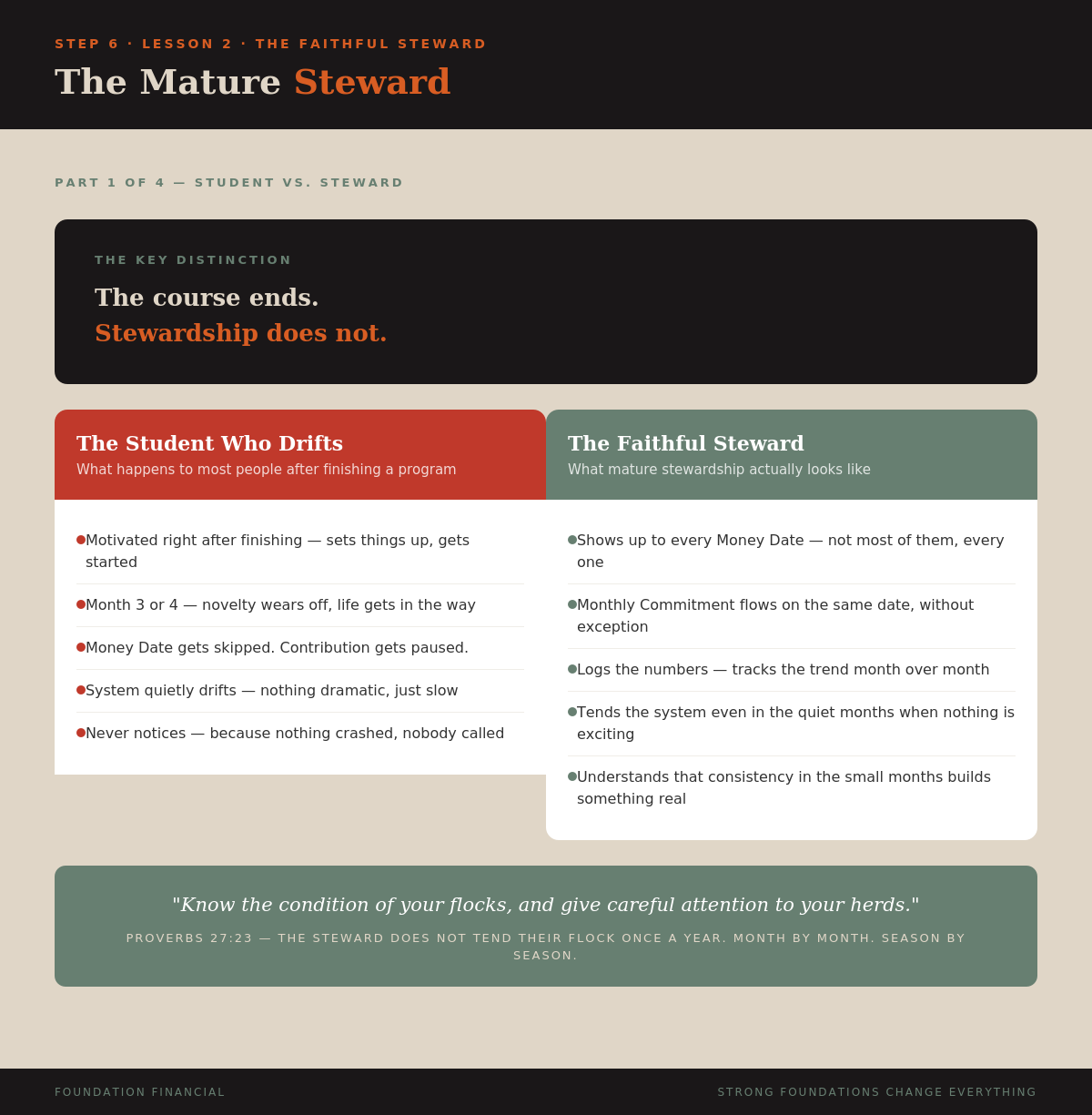
There is a difference between someone who completed a course and someone who is a steward.
Most people who go through a financial program feel motivated when they finish. They set things up. They get started. And then somewhere between month three and month six, the novelty wears off and life gets in the way. The Money Date gets skipped. The contribution gets paused. The system quietly drifts.
And they never even notice, because nothing dramatic happened. The account did not crash. Nobody called them. It just slowed down.
The faithful steward does not tend their flock once a year. They know the condition of their flock — month by month, season by season. They show up even when nothing exciting is happening, because they understand that faithfulness in the quiet months is what builds something real.
"Know the condition of your flocks, and give careful attention to your herds." — Proverbs 27:23
The Quarterly Stewardship Audit
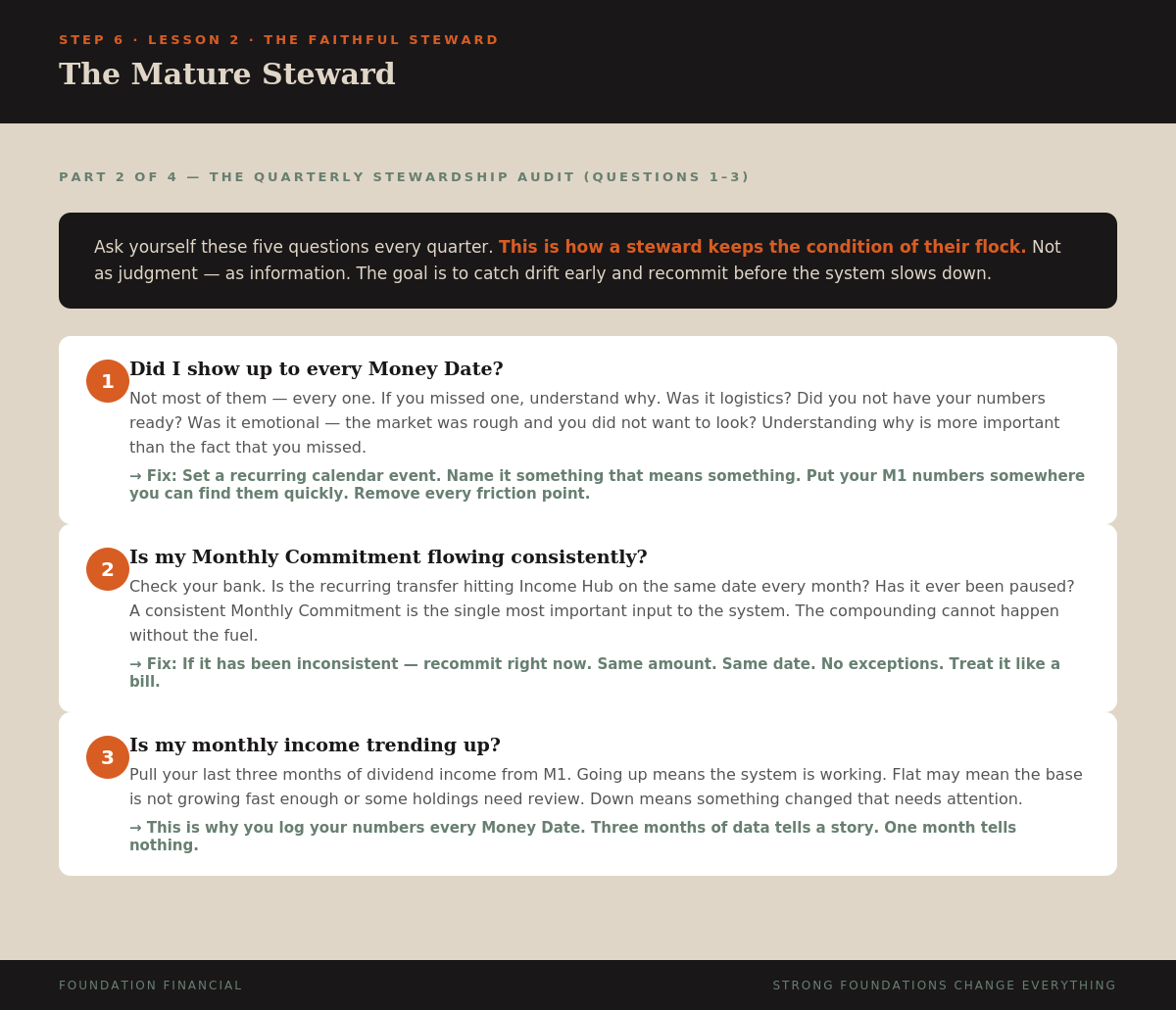
Ask yourself these five questions every 90 days. Not as judgment — as information. The goal is to catch drift early and recommit before the system slows down.
Question 1 — Did I show up to every Money Date?
Not most of them. Every one. If you missed one, understand why. Was it logistics — you did not have your numbers ready? Was it emotional — the market was rough and you did not want to look? Understanding why is more important than the fact that you missed.
Fix the logistics. Set a recurring calendar event. Name it something that means something to you. Put your M1 numbers somewhere accessible. Remove every friction point that might cause you to skip next month.
Question 2 — Is my Monthly Commitment flowing consistently?
Check your bank. Is the recurring transfer hitting Income Hub on the same date every month? Has it ever been paused? A consistent Monthly Commitment is the single most important input to the system. The compounding cannot happen without the fuel.
If it has been inconsistent — recommit right now. Same amount. Same date. No exceptions. Treat it like a bill.
Question 3 — Is my monthly income trending up?
Pull your last three months of dividend income from M1. Going up means the system is working. Flat may mean the base is not growing fast enough, or some holdings need review. Down means something changed in the portfolio that needs attention.
This is why you log your numbers every Money Date. Three months of data tells a story. One month tells nothing.
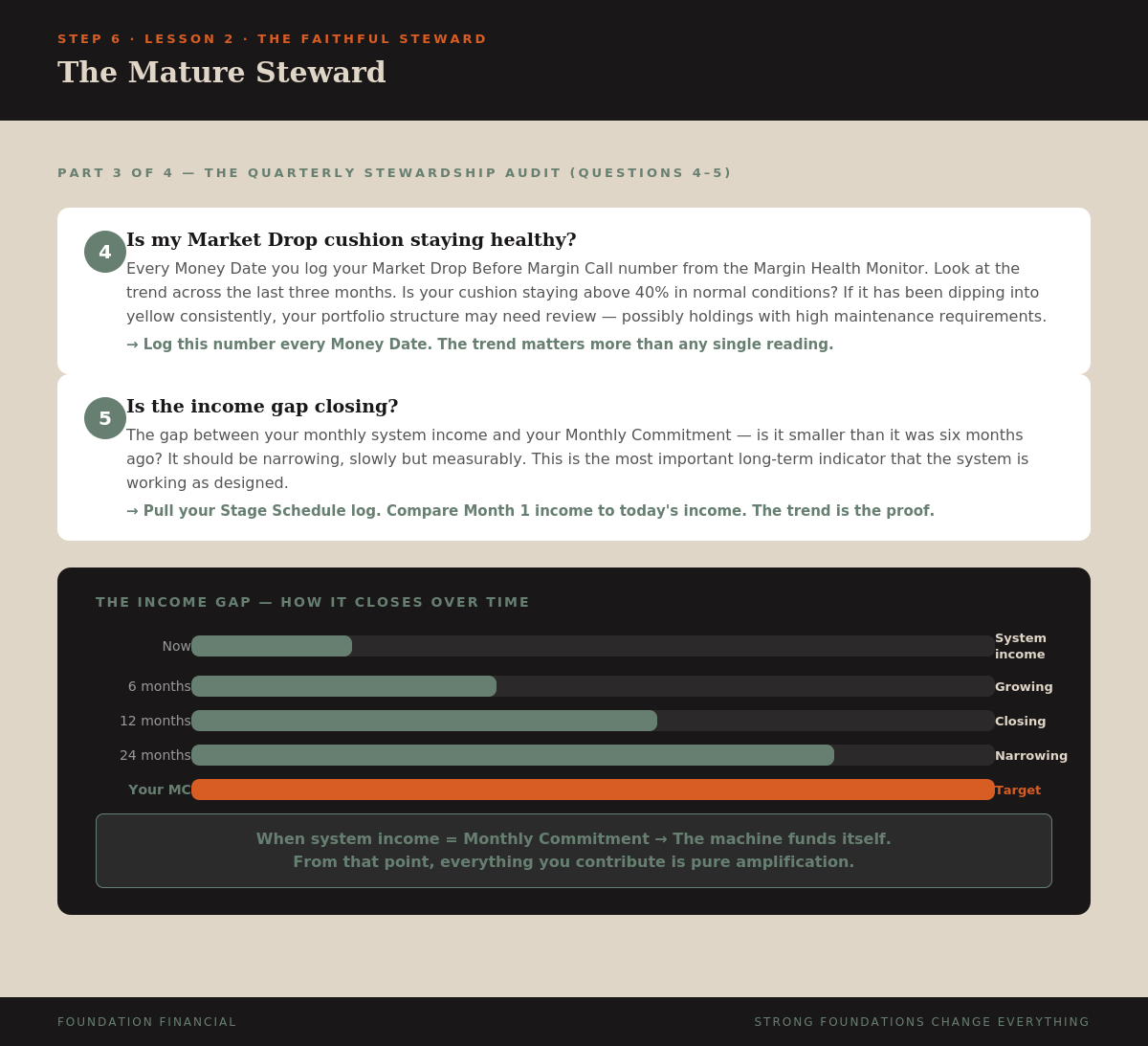
Question 4 — Is my Market Drop cushion staying healthy?
Every Money Date you log your Market Drop Before Margin Call number from the Margin Health Monitor. Look at the trend across the last three months. Is your cushion staying above 40% in normal conditions? If it has been dipping into yellow consistently, your portfolio structure may need attention.
Question 5 — Is the income gap closing?
The gap between your monthly system income and your Monthly Commitment — is it smaller than it was six months ago? It should be narrowing, slowly but measurably. Pull your Stage Schedule log and compare Month 1 income to today's income. The trend is the proof.
The Aspirational Endpoint
When system income equals your Monthly Commitment — the machine funds itself. From that point, anything you contribute becomes pure amplification.
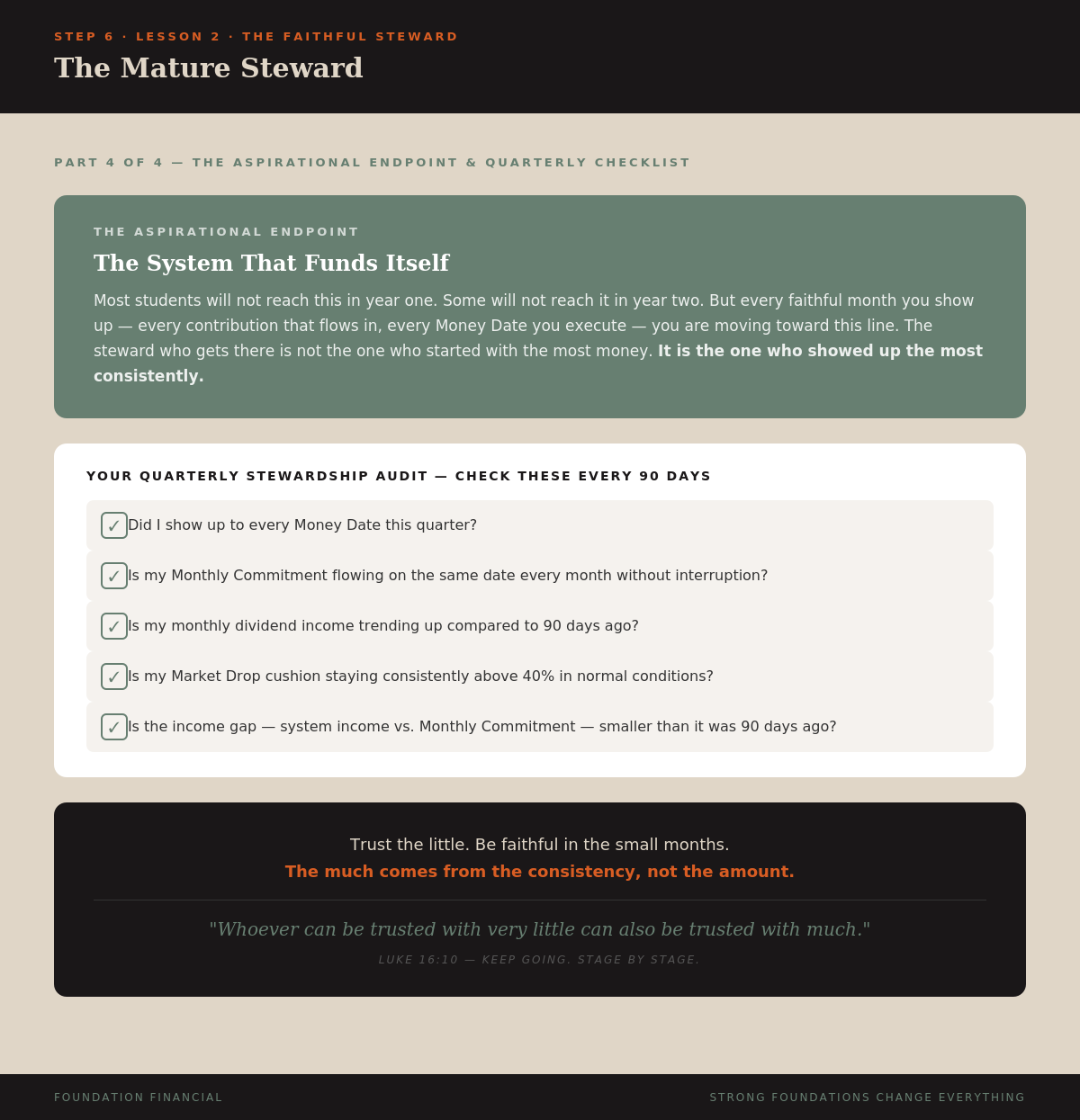
Most students will not reach that endpoint in year one. Some will not reach it in year two. But every faithful month you show up, every contribution that flows in, every Money Date you execute — you are moving toward that line.
The steward who gets there is not the one who started with the most money. It is the one who showed up the most consistently. Month after month after month.
Your Quarterly Checklist
Run this every 90 days:
- Did I show up to every Money Date this quarter?
- Is my Monthly Commitment flowing on the same date every month?
- Is my monthly dividend income trending up vs. 90 days ago?
- Is my Market Drop cushion staying consistently above 40%?
- Is the income gap smaller than it was 90 days ago?
"Whoever can be trusted with very little can also be trusted with much." — Luke 16:10
Trust the little. Be faithful in the small months. The much comes from the consistency, not the amount.
Key Takeaway
The course ends but stewardship does not. Run a Quarterly Stewardship Audit every 90 days: check your Money Date attendance, contribution consistency, income trend, margin cushion, and whether the income gap is closing. The steward who reaches the endpoint is not the one who started with the most — it is the one who showed up the most consistently.