Education Series
The Big Picture Solution
How the Blueprint solves the wealth-building math problem that traditional saving never could.
Lesson 1
A Different Way to Think About Money
Video
Infographics
Lesson Text
What You'll Learn
Most people are focused on the wrong number. This lesson explains why — and introduces the mindset shift that makes The Blueprint work.
The Rate Game
Here's how most people think about money: find the best return percentage you can and put your savings there. Chase the highest yield. Move from a 4% savings account to a 5% one. Hunt for the fund that beat the market last year.
It's called the rate game. And the financial industry is built on keeping you focused on it.
The problem is that the rate is not the most important number. The base is.
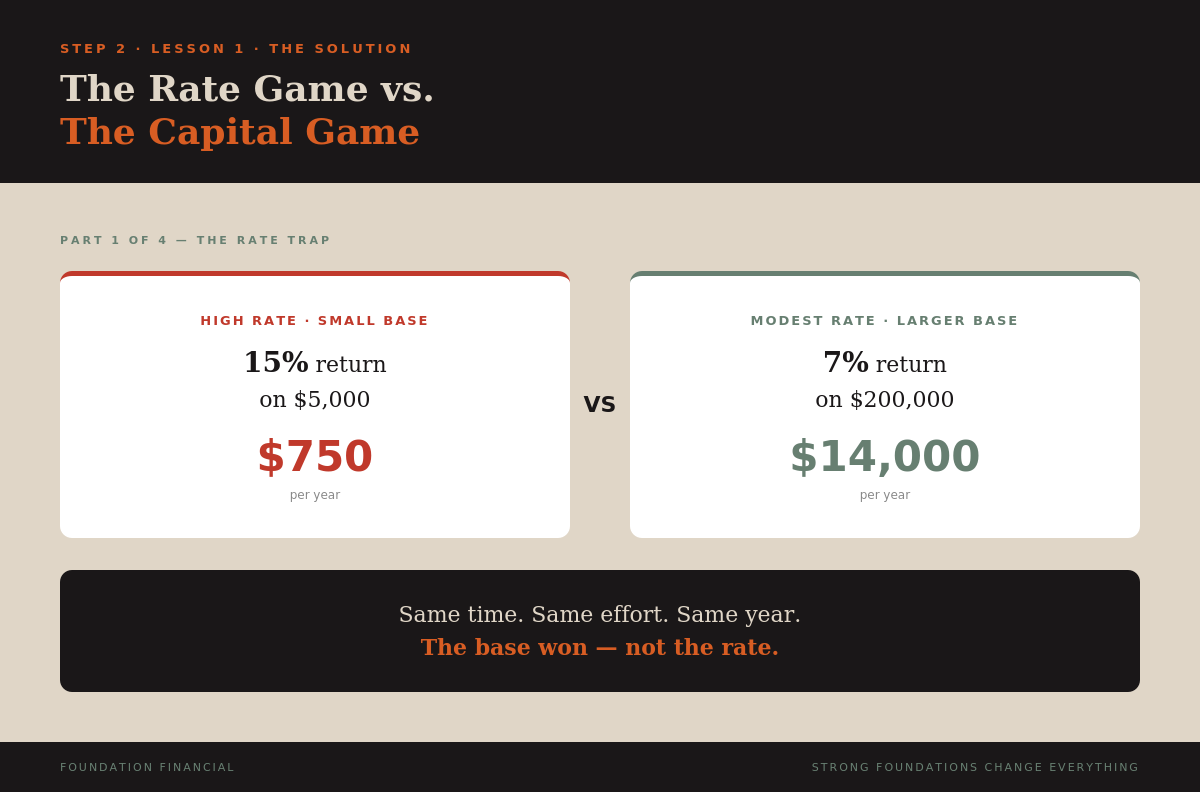
A 15% return on $5,000 produces $750 a year.
A 7% return on $200,000 produces $14,000 a year.
Same time. Same effort. Completely different life. The rate didn't win — the capital base did.
This is the shift The Blueprint is built on. Stop optimizing the rate. Start building the base.
The Capital Game
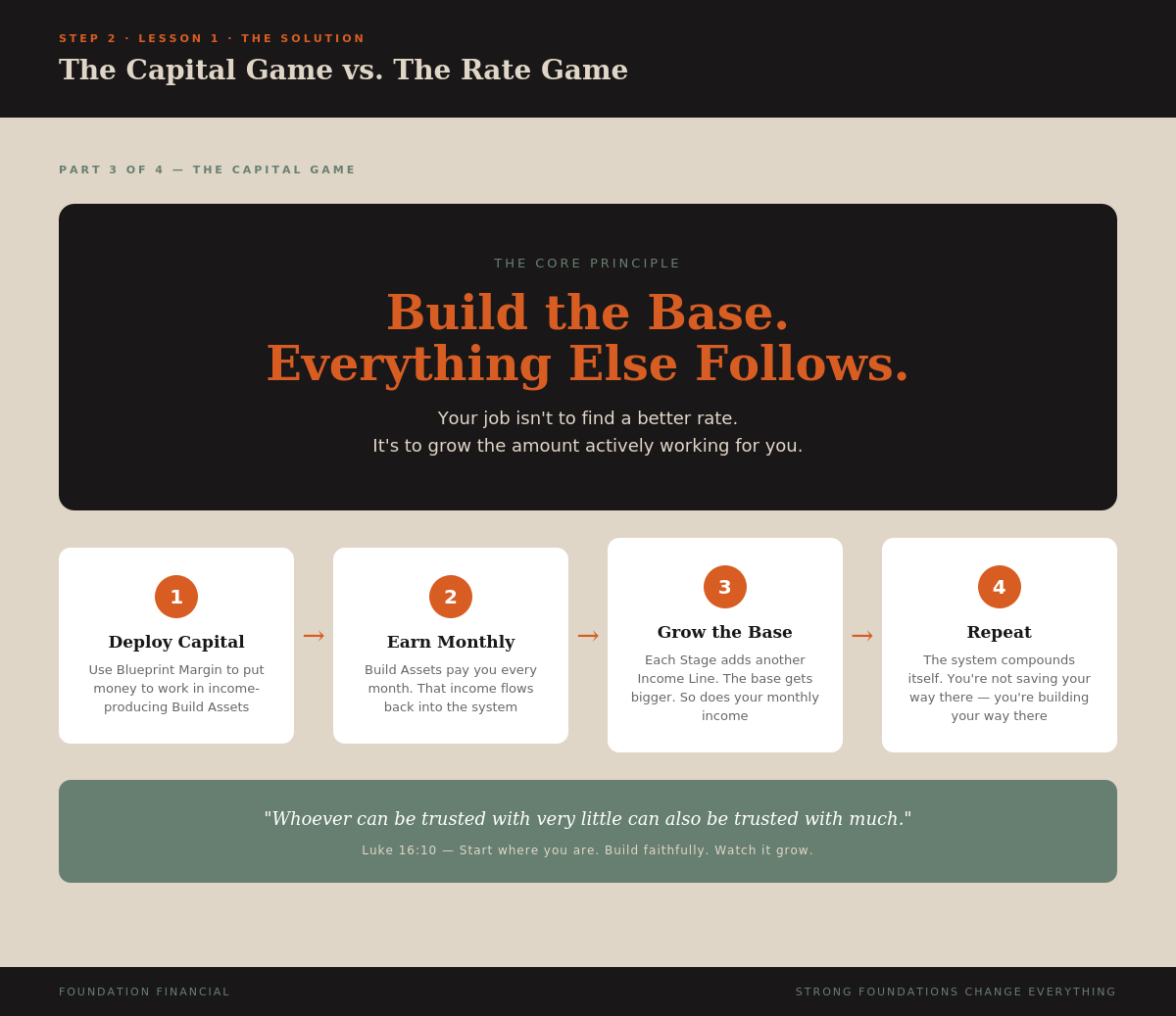
The capital game is simple: your job is to grow the total amount of money actively working for you — as fast as possible. Once the base is large enough, even average returns produce income that changes your family's life.
The Blueprint grows your capital base faster than saving alone through the strategic use of margin — borrowed capital inside your investment account, deployed into income-producing assets that pay you back every month.
Most people hear the word "margin" and think danger. They've been told their whole lives that debt is bad. But that framing has kept a lot of families from ever building anything real.
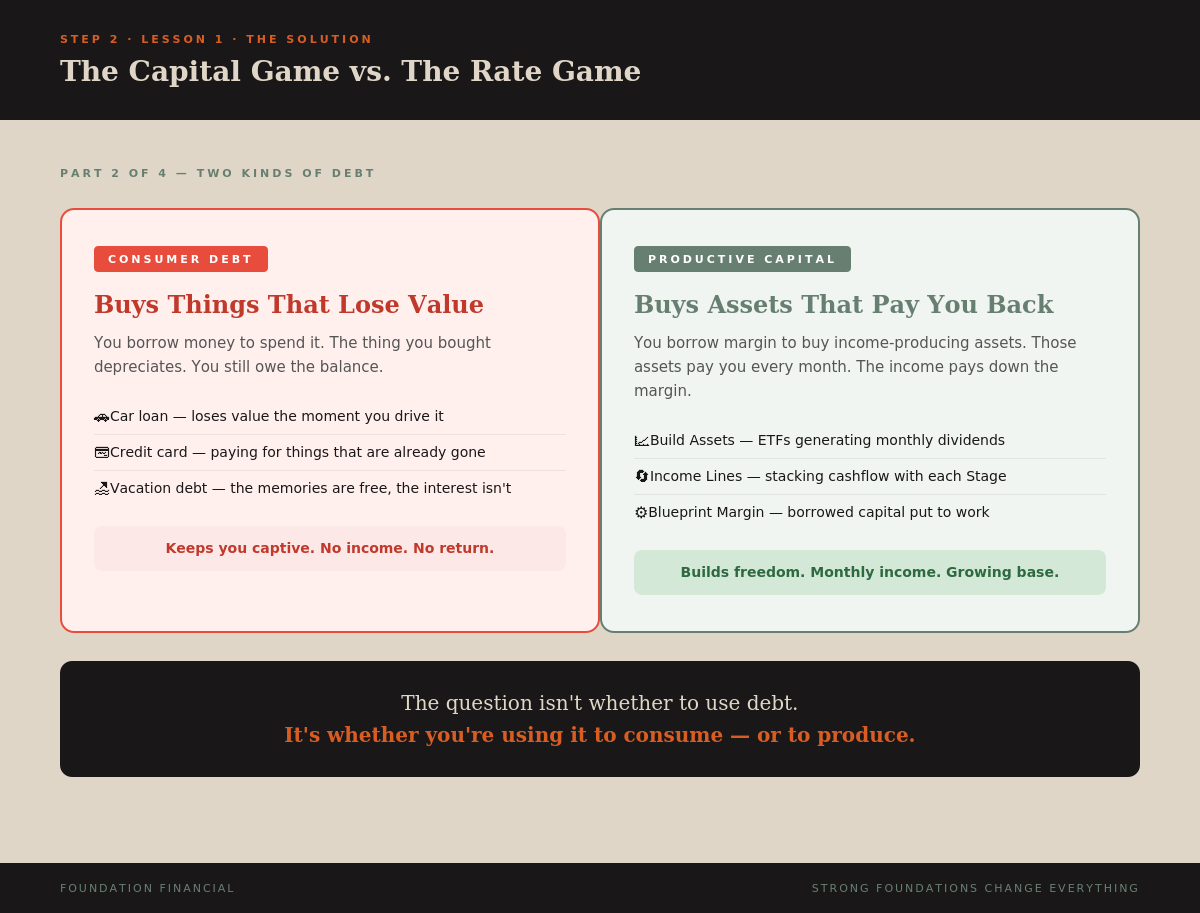
Debt is a tool. Consumer debt buys things that lose value — cars, vacations, stuff. It keeps you captive. The Blueprint uses borrowed capital to buy assets that produce monthly income. That's not the debt that traps you. That's the capital that frees you.
The Stewardship Foundation
This is more than a financial strategy. It's a stewardship principle.
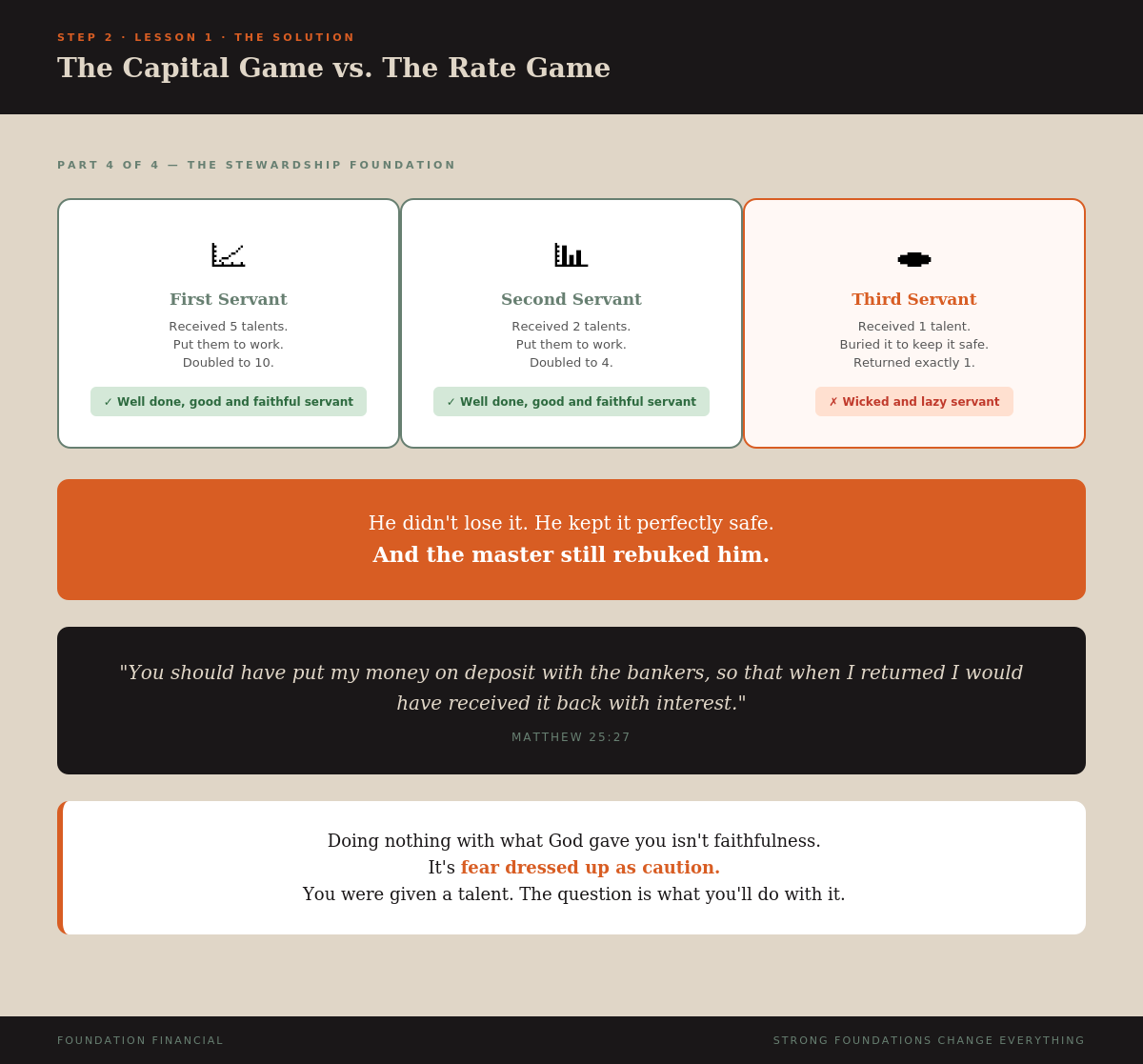
In Matthew 25, a master distributes talents — capital — to three servants before a long journey. Two of them invested and multiplied what they were given. One buried his in the ground, keeping it safe.
When the master returned, he didn't rebuke the servant for losing the talent. He rebuked him for doing nothing with it.
"You should have put my money on deposit with the bankers, so that when I returned I would have received it back with interest." — Matthew 25:27
Doing nothing with what God has given you isn't faithfulness. It's fear dressed up as caution. The Blueprint is built on the conviction that faithful stewardship means putting what you've been given to work — so you can give more, serve more, and be present for your family.
The Mindset Shift
Leaving this lesson, carry one question with you:
"How do I grow the base of capital working for me?"
Not "what's the best rate I can find?" The rate matters. But the base matters more.
In the next lesson, you'll see exactly how The Blueprint builds that base — step by step, with real numbers.
"Whoever can be trusted with very little can also be trusted with much." — Luke 16:10
Key Takeaway
The rate is not the most important number — the base is. A 7% return on $200,000 beats a 15% return on $5,000 every time. The Blueprint grows your capital base faster than saving alone by deploying margin into income-producing assets. Stop chasing rates. Start building the base.
Lesson 2
How The Blueprint Works
Video
Infographics
Lesson Text
What You'll Learn
The Blueprint runs on a continuous monthly loop. This lesson walks you through exactly how it works — from deploying margin to earning dividends to your monthly Build Check-In — so you understand the mechanics before you build anything.
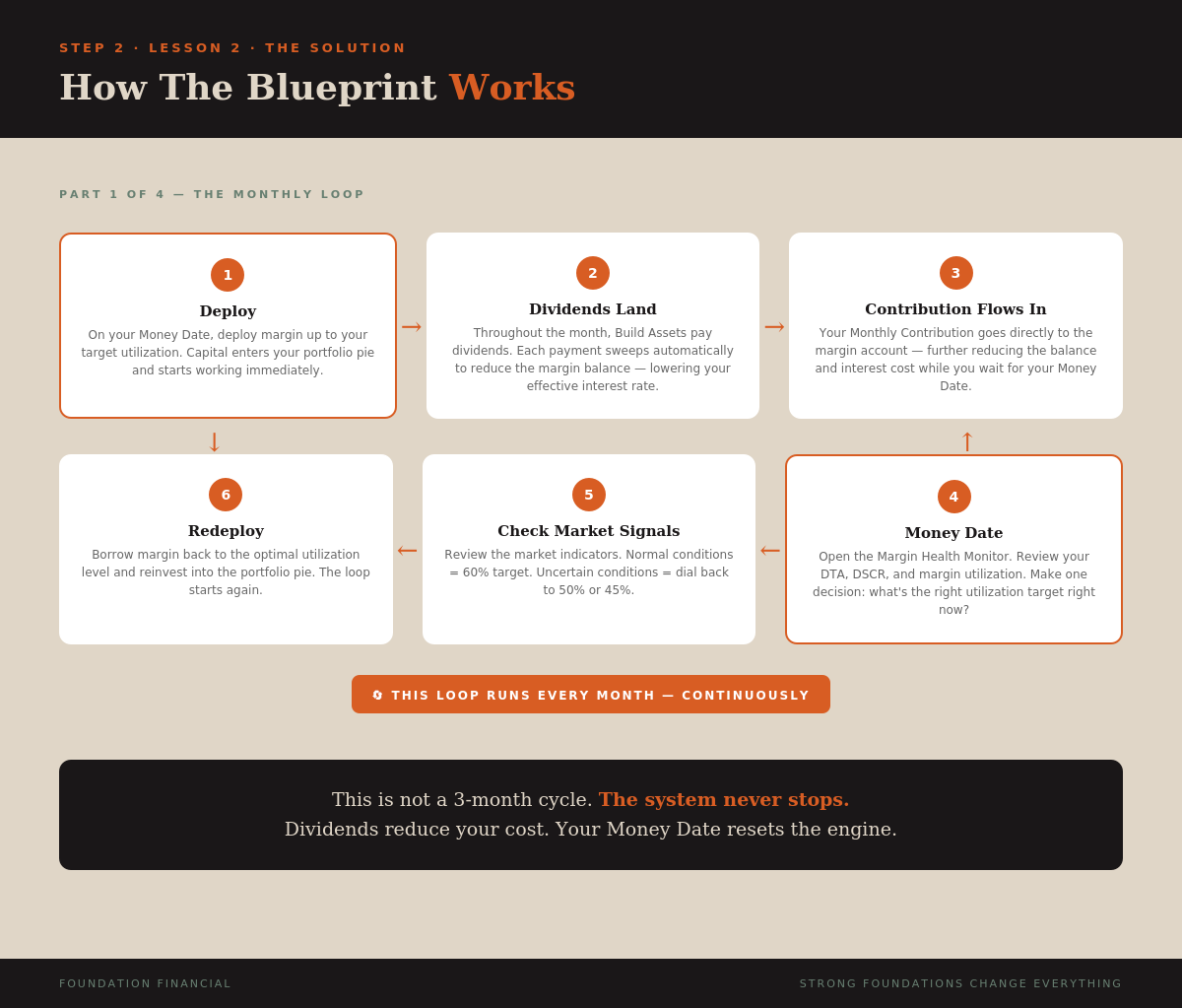
The Loop
Every month The Blueprint follows the same cycle. On your Money Date you deploy margin up to your target utilization rate. That capital goes into your portfolio and starts working in your Build Assets — the income-producing ETFs that pay you monthly dividends. Throughout the month those dividends flow automatically to reduce your margin balance, lowering your effective interest rate. Your Monthly Contribution flows in and does the same thing. Then your next Money Date arrives, you check your numbers, and you redeploy back to the optimal level.
Deploy. Earn. Reduce. Redeploy. Repeat.
This is not a 3-month pay-down cycle. The system never stops. It runs every single month, continuously.
Margin Utilization — Your Key Number
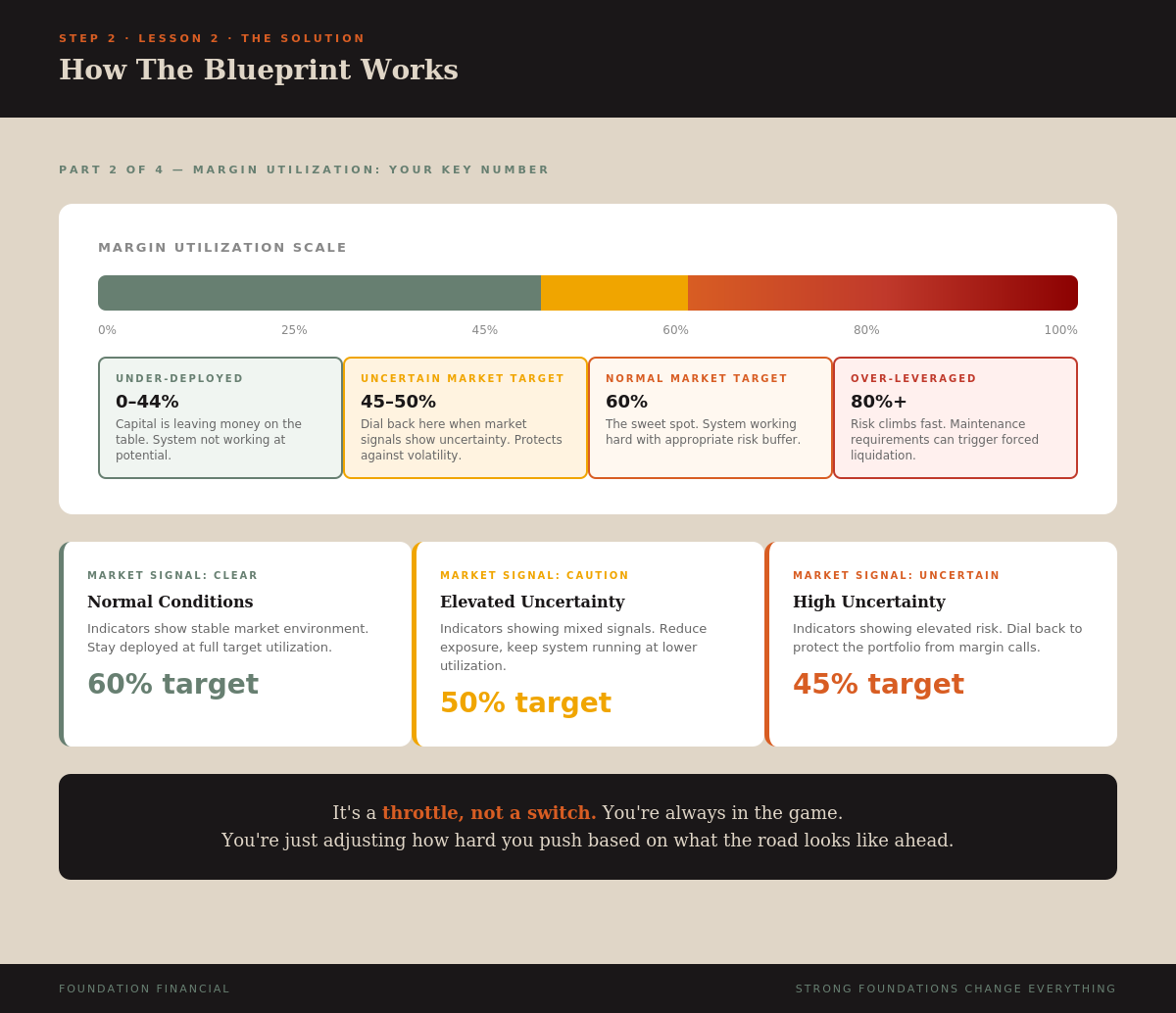
Margin utilization is simply how much of your available margin you are actually using. If you have $10,000 in available margin and you have borrowed $6,000, your utilization is 60%.
In normal market conditions, the target is 60% utilization. Not higher — that is where risk starts to climb. Not lower — that is leaving money on the table. 60% is the sweet spot where the system is working hard with an appropriate buffer.
When markets get uncertain, you dial back:
- Normal conditions → 60% target
- Caution signals → 50% target
- High uncertainty → 45% target
Think of it like a throttle, not an on-off switch. You are always in the game. You are just adjusting how hard you are pushing based on what the road looks like ahead. The market signals — which we will cover in a later lesson — tell you which target to aim for each month.
What Happens During the Month
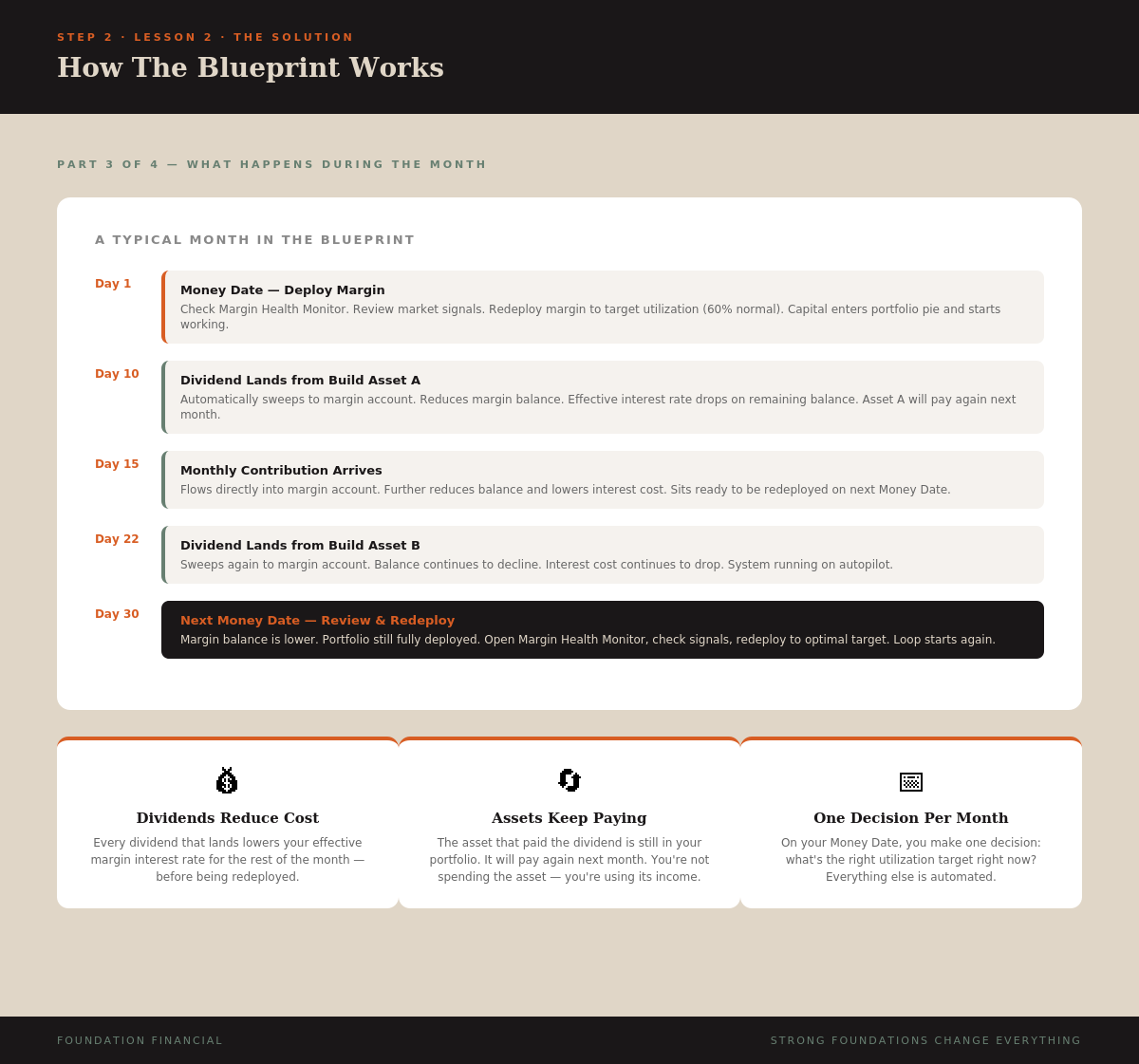
Let's walk through a typical month.
On Day 1 — your Money Date — you open the Margin Health Monitor, review your metrics and market signals, and redeploy margin to your target utilization. Capital enters your portfolio pie and starts working.
On Day 10, a dividend lands from one of your Build Assets. It sweeps automatically to your margin account and reduces the balance. Here is the important part: the moment that dividend reduces your margin balance, your effective interest rate on the remaining balance drops. You are paying interest on less. And the asset that just paid you that dividend is still sitting in your portfolio. It will pay you again next month.
Your Monthly Contribution works the same way. As soon as it arrives it flows directly to your margin account, further reducing the balance and lowering your interest cost while you wait for your next Money Date.
More dividends may land later in the month from other Build Assets. Every one of them reduces your cost a little further.
By the time your next Money Date arrives, your margin balance is lower, your interest costs have been reduced all month, and your portfolio is still fully deployed and working.
You open the Margin Health Monitor. You check your metrics. You look at the market signals. You redeploy to the right target. The loop starts again.
How It Compounds Over Time
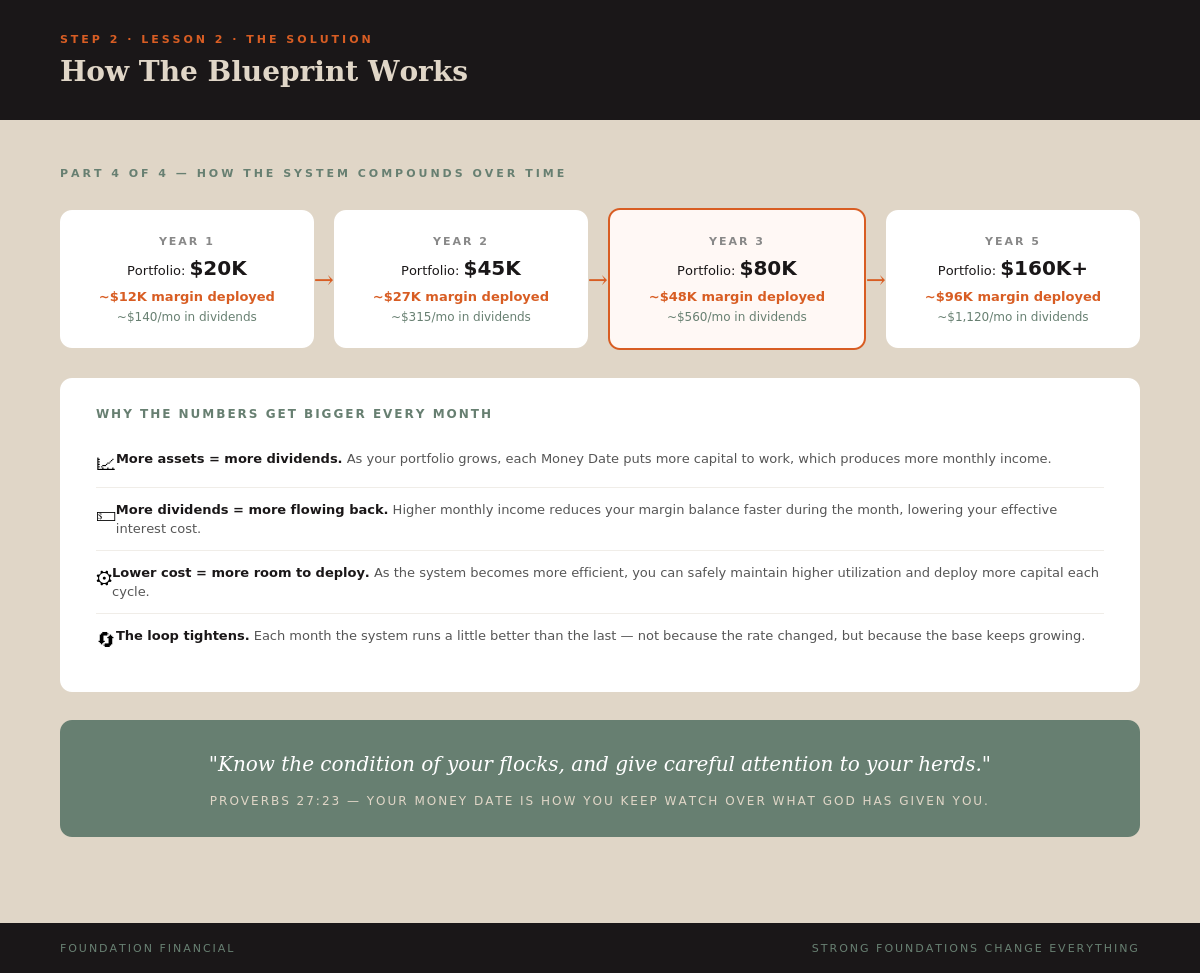
Here is why the system gets more powerful the longer it runs.
More assets mean more dividends. More dividends mean more flowing back to reduce your margin cost during the month. A lower cost base means the system runs more efficiently. And as your portfolio grows, the amount you can safely deploy at each Money Date grows with it.
You are not chasing a better rate. You are building a bigger base that generates more income, which funds more growth.
The system rewards consistency. Every month the loop runs a little more effectively than the month before — not because anything changed in the market, but because your capital base keeps compounding.
"Know the condition of your flocks, and give careful attention to your herds." — Proverbs 27:23
Your Money Date is exactly that. Once a month, you know the condition of your system. Not guessing. Not hoping. Managing — with real numbers, real tools, and a clear process.
Key Takeaway
The Blueprint runs on a continuous monthly loop: Deploy margin to your target utilization, earn dividends from Build Assets, let those dividends reduce your margin cost, then redeploy at your next Money Date. The system compounds — more assets mean more dividends, which fund more growth. You manage it with one monthly check-in.
Lesson 3
What Makes This Different
Video
Infographics
Lesson Text
What You'll Learn
There is a lot of investing advice out there. This lesson explains what makes The Blueprint fundamentally different — and why those differences matter for your family right now, not someday.
Difference 1 — How Capital Gets Deployed
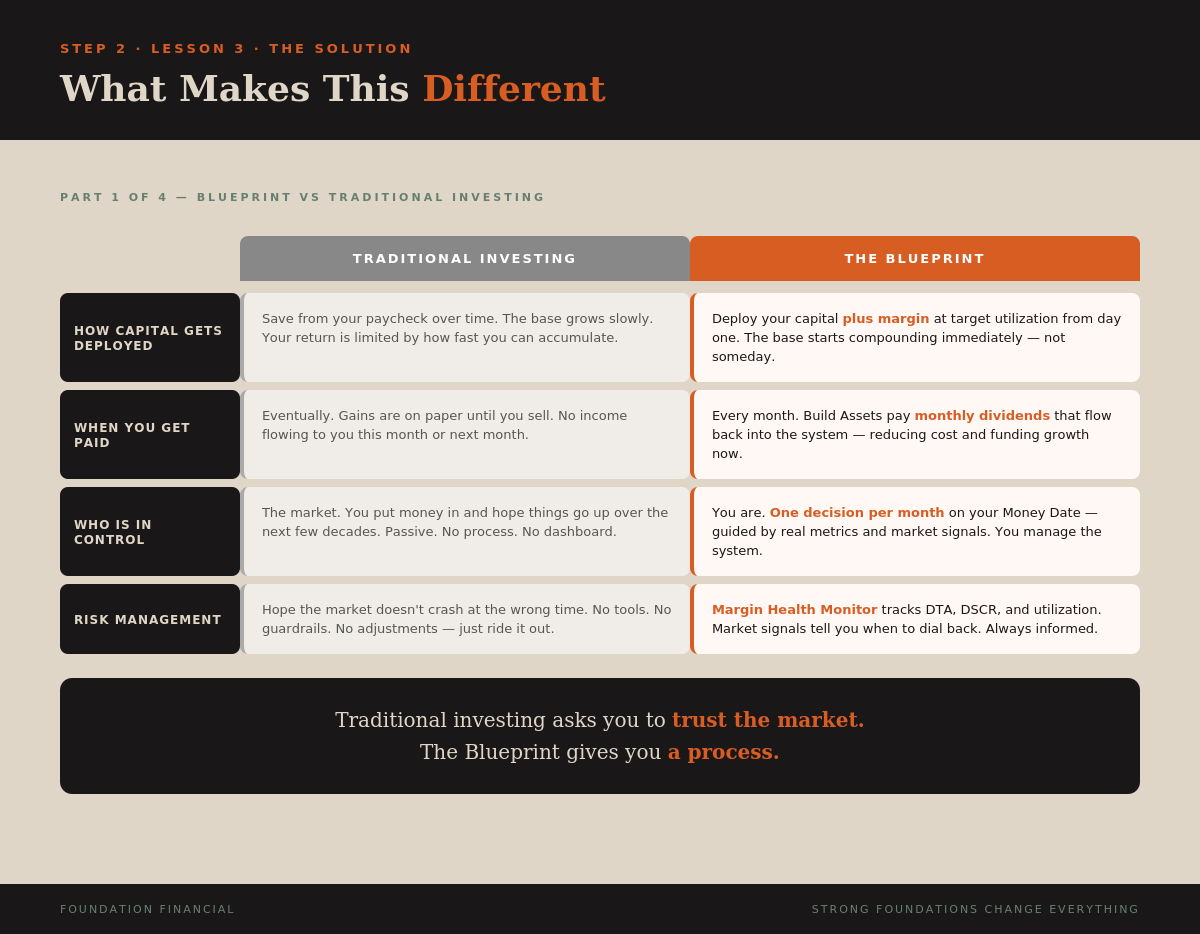
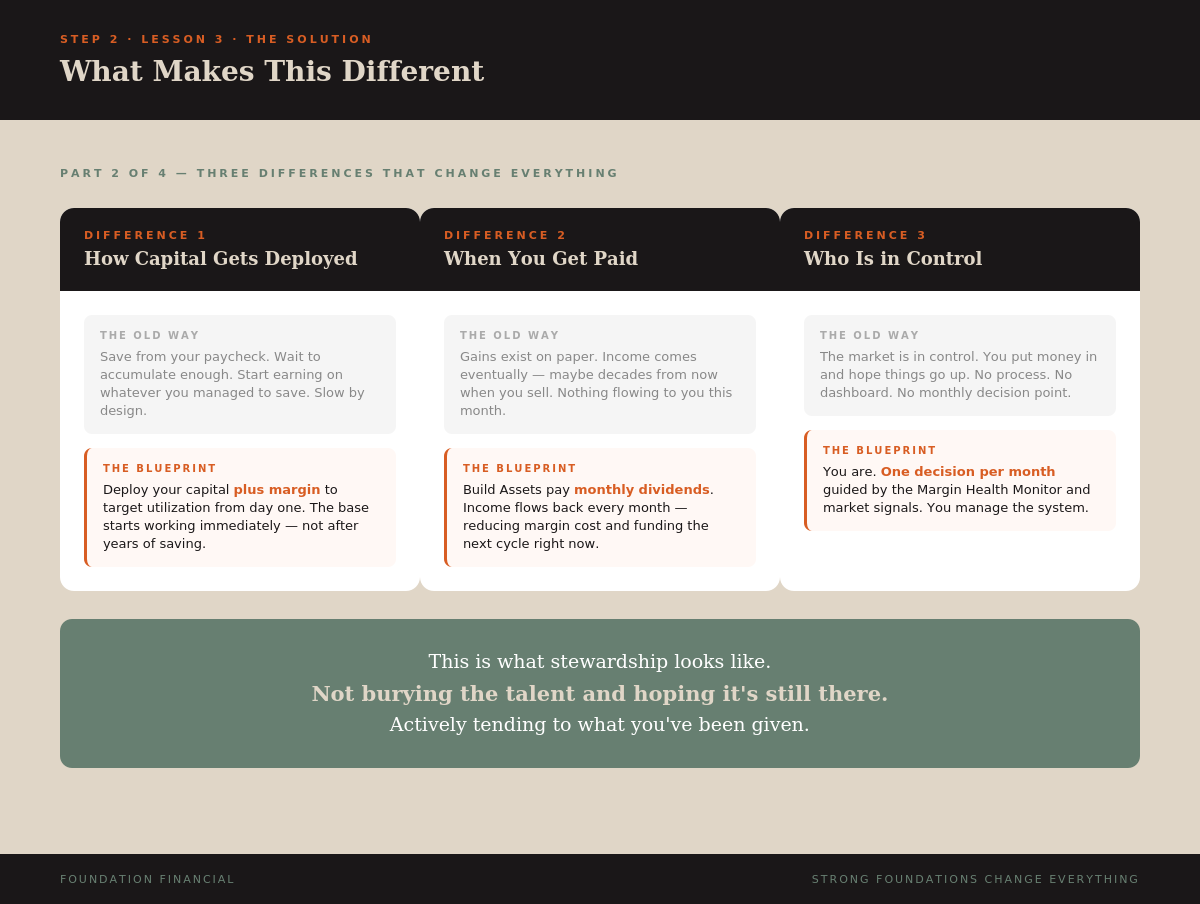
In traditional investing, you save from your paycheck over time and put it in. You earn a return on whatever you have managed to accumulate. The limiting factor is how fast you can save — and for most families, that is very slow.
The Blueprint uses margin — borrowed capital against your portfolio — to put more to work immediately. You deploy your own capital plus margin to your target utilization level from day one. The base starts compounding now. Not after years of saving.
This is not reckless. The Margin Health Monitor tracks your debt to asset ratio, debt service coverage ratio, and utilization at all times. Market signals tell you when to deploy aggressively and when to pull back. You are never flying blind. You have a dashboard.
Difference 2 — When You Get Paid
Traditional buy-and-hold investing pays you eventually. Gains exist on paper until you sell. There is no income flowing to you this month or next month or the month after.
The Blueprint pays you now. Every Build Asset in your portfolio is chosen specifically because it produces monthly dividends. That income flows back into the system every single month — reducing your margin cost and funding the next cycle.
And here is what matters for your family: that income grows every month. Not because the market went up. Because the base is growing. Because more assets mean more dividends. Because every dollar your contributions and dividends put back into the system gets redeployed at the next Money Date.
Difference 3 — Who Is in Control
Traditional investing asks you to trust the market. Put money in, leave it alone, and hope things go up over the next few decades. The market is in control. You are just along for the ride.
The Blueprint gives you a process. Once a month on your Money Date, you open the Margin Health Monitor and make one decision — what is the right utilization target right now given current conditions? Clear inputs. Clear outputs. You manage the system. The system does not manage you.
This is what stewardship actually looks like. Not burying the talent and hoping it is still there when you come back. Actively tending to what you have been given. Knowing the condition of your flocks.
Margin as an Amplifier — Not a Risk
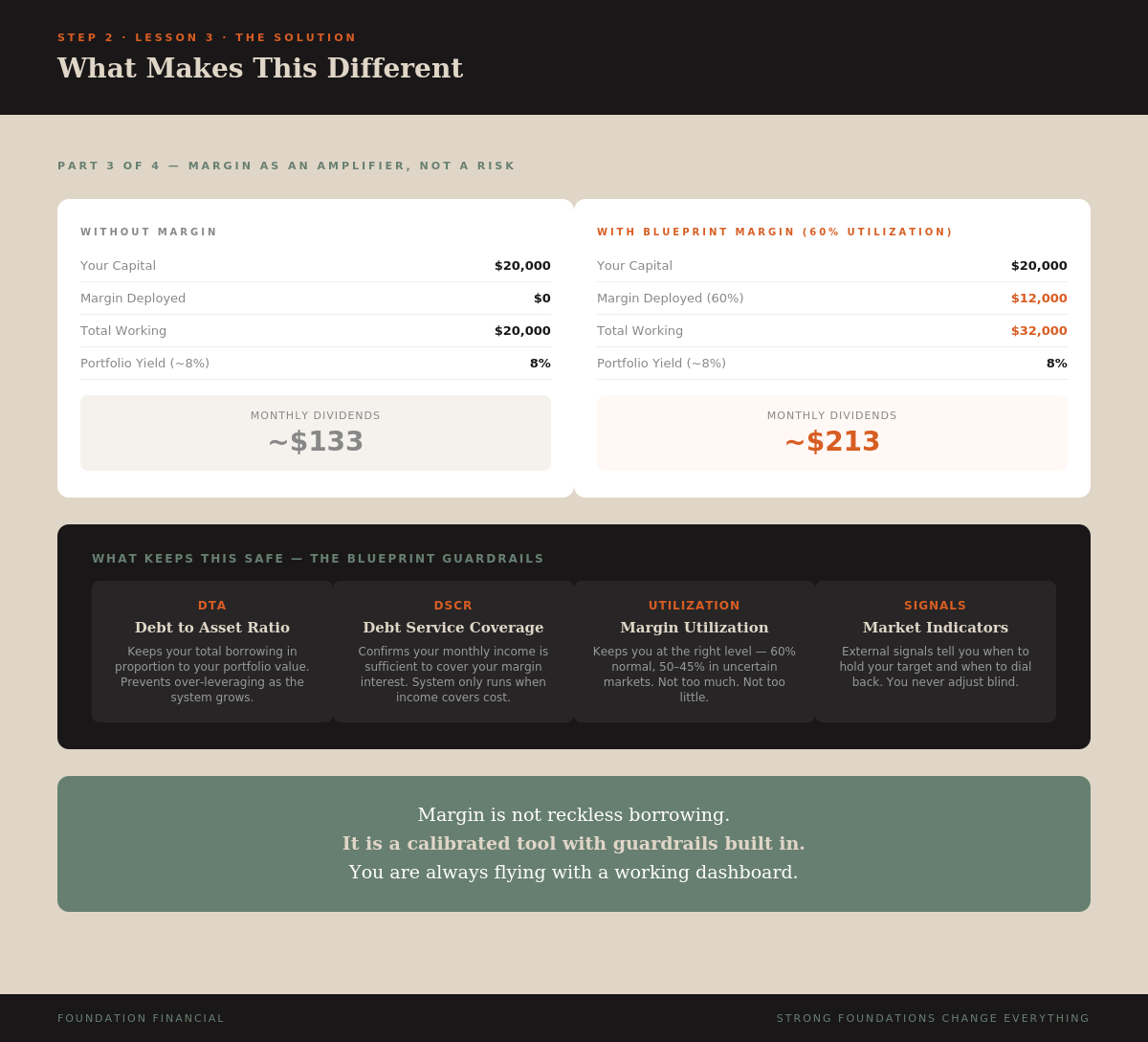
When most people hear the word margin they think danger. But used correctly with guardrails in place, margin is simply a tool that amplifies what your capital base can produce.
Without margin, $20,000 at an 8% blended yield generates about $133 a month in dividends. With Blueprint Margin at 60% utilization, that same $20,000 in your capital controls $32,000 in total assets — generating around $213 a month. Same yield. Bigger base. More income.
The guardrails built into the system — your DTA, DSCR, utilization target, and market signals — exist specifically to make sure the amplifier never runs ahead of the safety buffer. Controlled. Measured. Always informed.
Your Simple Start
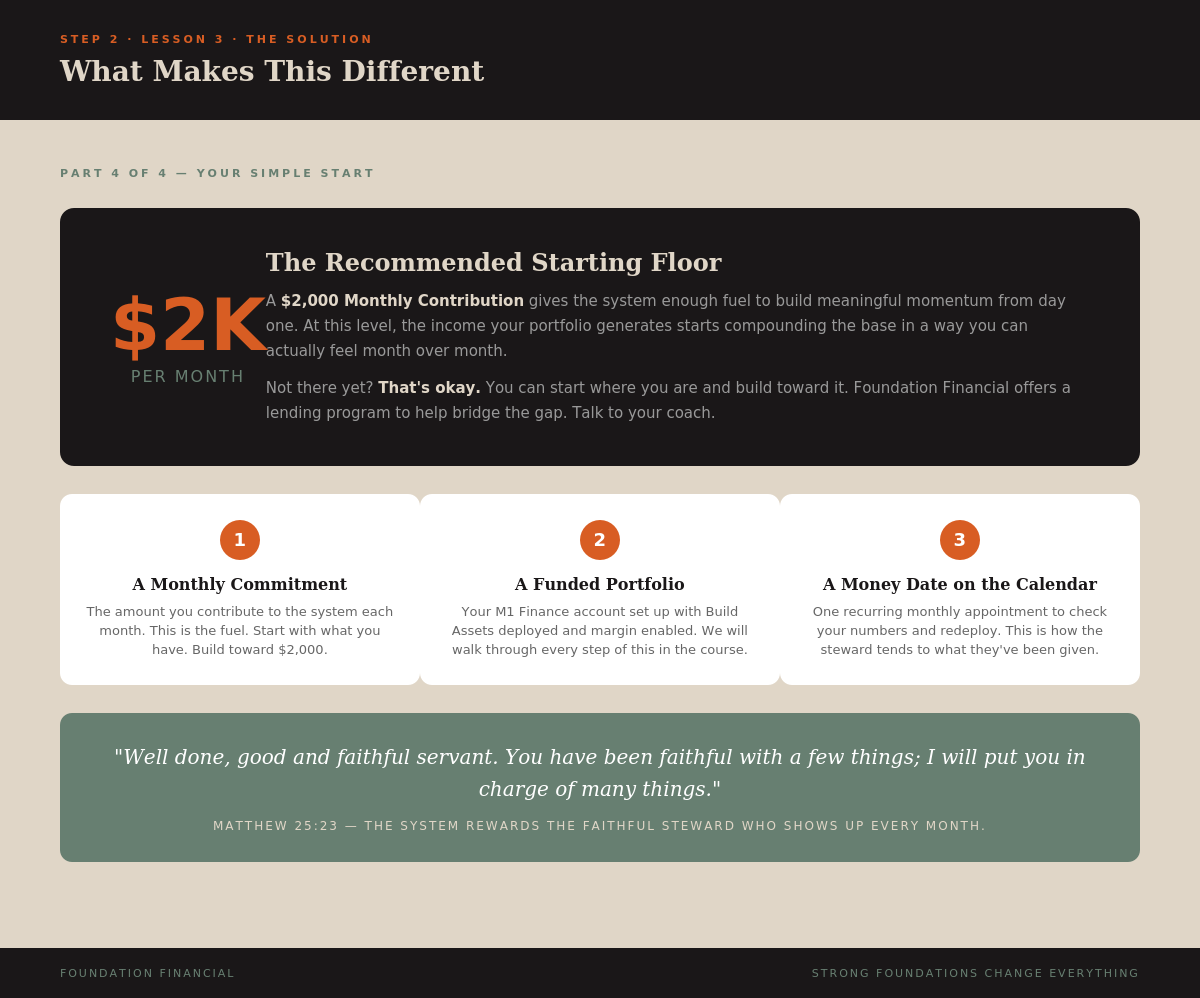
The Blueprint works best with a Monthly Contribution of $2,000 or more. That is the recommended starting floor — the amount that gives the system enough fuel to build real momentum from day one.
If you are not there yet, that is okay. You can start where you are and work toward it. Foundation Financial also offers a lending program to help students bridge the gap. Your coach can walk you through the options.
Here is what you need to begin:
- A Monthly Commitment — the amount you contribute each month
- A funded portfolio — your M1 Finance account with Build Assets deployed
- A Money Date on the calendar — your monthly check-in appointment
You do not need to have it all figured out before you start. You need a commitment, a portfolio, and a process.
"Well done, good and faithful servant. You have been faithful with a few things; I will put you in charge of many things." — Matthew 25:23
The system rewards the steward who shows up every month and does the work.
Key Takeaway
The Blueprint is fundamentally different in three ways: it deploys capital immediately through margin instead of waiting years to save, it pays you monthly dividends instead of paper gains, and it gives you a managed process instead of hoping the market goes up. Start with a monthly commitment, a funded portfolio, and a Money Date.
You See the Solution
You understand the mindset shift from rates to capital base. You've seen how the monthly loop compounds over time. And you know what makes The Blueprint fundamentally different from traditional investing.
Next: See exactly what you're building inside the Blueprint.
Next: What You're Building →